Mudita Studios ResearchThe Studio Series
Exit by DesignAre Studio Companies Built to Be Acquired?
We checked 151 claimed venture-studio exits and kept the 109 we could verify as studio-built. Studio companies sell early, mostly to operating companies, and usually raise little before they sell. That fits the "built to be acquired" story. Whether it means better returns depends on what the disclosed deals don't show.
Executive summary
We verified 109 venture-studio exits to test whether studio companies are built to be acquired. For corporate buyers and investors, the data shows how studio companies sell, to whom and at what age, and where public deal data runs out.
- 01
86%
of 97 verified digital-studio exits were acquisitions or mergers
Studio companies are sold, rarely listed
For exits since 2015 the figure is 89%, matching Max Pog's count. Flagship, the biotech outlier, exited 11 of its 12 companies by IPO.
- 02
5 yrs
median time from founding to acquisition
Sales come at about the same age as VC
PitchBook puts the VC-backed median at 4.9 years, measured from the first VC round. Studio software IPOs did come earlier than their cohort, by a median of 2.8 years.
- 03
96%
of acquirers were operating companies
Buyers are strategic
Only 3 of 84 acquisitions went to financial buyers, and 39% of buyers were enterprise software or security companies.
- 04
4.1x
median exit value over capital raised, across 49 disclosed exits
Disclosed deals look efficient, and most deals are undisclosed
Just 32% of acquisitions disclose a price. If every undisclosed exit with known capital had returned 1x, the median multiple across 98 exits would fall to 1.0x.
- 05
6 of 11
Flagship IPOs that ended in liquidation or bankruptcy
Many exits went bad later
Across all 109 exits, 26 carry a warning flag, including 15 companies later shut down and 4 resold at a fraction of the price.
01
The claim, and why it needs testing
Venture studios argue that their companies are designed for a sale. A studio starts from a validated thesis, owns a meaningful share of each company, and raises outside capital late and in small amounts. On that logic, a $100 million acquisition can return to a studio what a $1 billion exit returns to a typical VC. The logic is attractive, but most of the numbers quoted for it are self-reported. The best-known figures come from a 2020 trade-body survey in which 14 studios reported returns. The one study built on independent PitchBook deal data, Malyy & Pog (December 2024), found that studio deals exited faster (4.5 years) but less often than pre-seed VC deals (24% vs 38%).
We therefore built our own dataset of exits. We started from studios' own portfolio pages, the Venture Studio Index list of large exits, and targeted searches. That gave 151 candidate exits: acquisitions, mergers, IPOs and SPAC listings. We then verified each one against acquirer press releases, SEC filings and contemporary press. For each exit we recorded the founding year, the exit year, the buyer, the buyer type and sector, the disclosed price, the capital raised beforehand, and what happened next.
A quarter of the claimed exits did not hold up. We excluded 37 of the 151 because the studio had invested in the company but had not built it, or because its role could not be established. The excluded companies include Dollar Shave Club (Science Inc. says it incubated the company, but the press lists Science as an investor and the founder conceived it in 2011), Bird (Science's own portfolio tags it as a fund investment), Talon and Dig Security (Team8 led their seed rounds; their founders started them independently), Lessonly and Octiv (both predate High Alpha's 2015 founding), HelloFresh (Rocket Internet was an early majority investor), and LowerMyBills and Tenor (Idealab). Delivery Hero was never in scope: Rocket built foodpanda and sold it to Delivery Hero in 2016, and foodpanda is in the dataset.
Two attributions we kept are contested. TechCrunch reported that Giphy was "first born out of betaworks' Hacker in Residence program," and betaworks claims it built Giphy. Other accounts list betaworks only as an investor. TweetDeck is similar: the New York Times says betaworks "helped give birth" to it, while TechCrunch credits the founder with the idea. Both are flagged as contested. Removing them leaves the M&A share at 77% and moves the median exit multiple from 4.1x to 4.2x (see Methodology).
That leaves 109 verified venture-studio exits from 15 studios: 97 from digital studios (led by Rocket Internet with 18, Idealab with 16, High Alpha with 13 and Hexa/eFounders with 12) and 12 from Flagship Pioneering, which we report separately. A further five verified exits were incubated in-house by VC firms (Sutter Hill and Greylock). That is a different model from a venture studio, so they are kept out of all studio figures and reported in a short note at the end (Table 4). We found no verifiable studio-built exit for Founders Factory or Wavemaker. Harlem Capital is a VC fund, not a studio.
02
1. Studio companies are sold, not listed
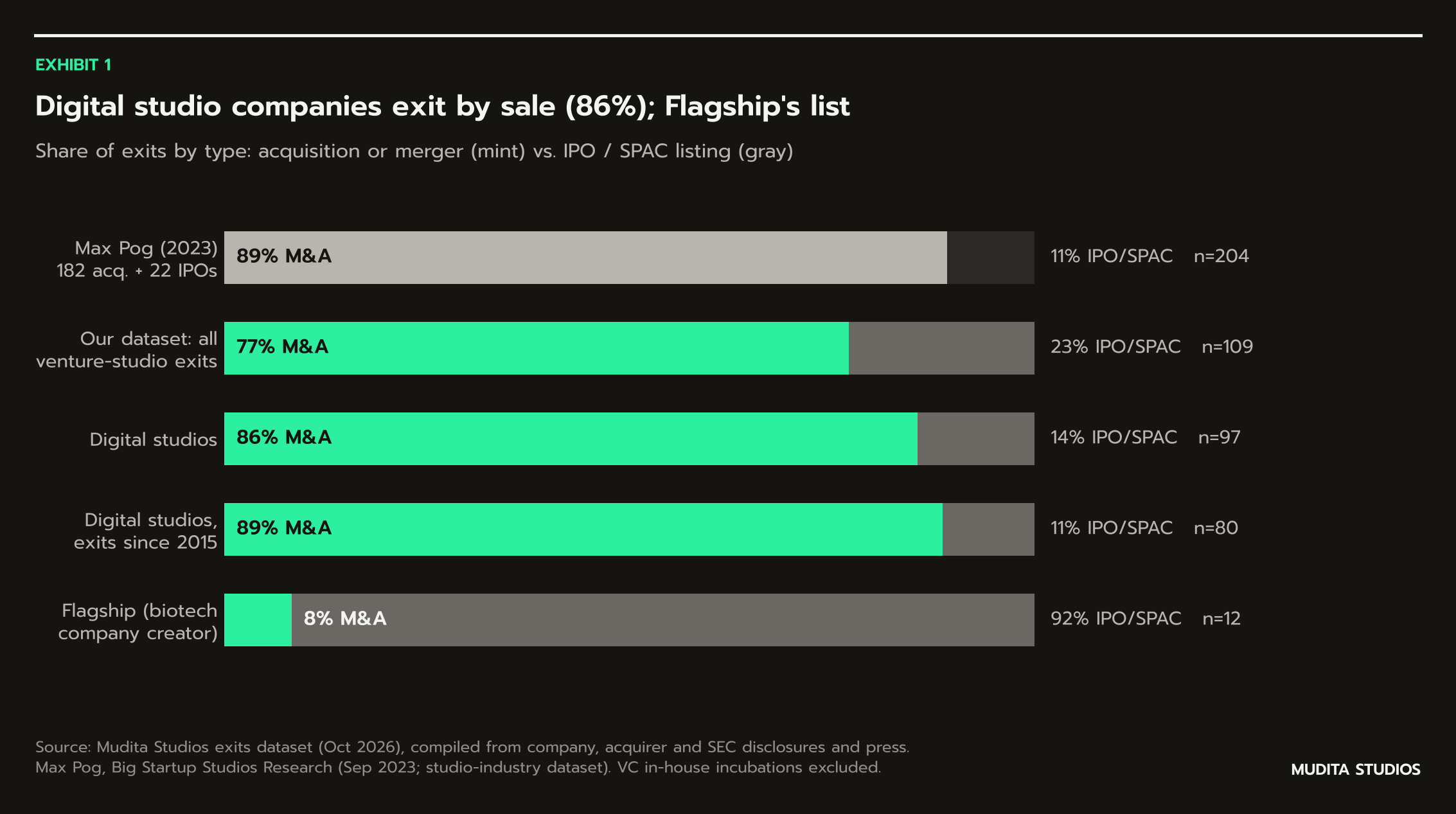
Exhibit 1 shows that digital studios exit almost entirely through M&A: 86% of all their exits, and 89% of exits since 2015. Excluding the two oldest studios (Rocket, Idealab) and Flagship, the figure is 95%. This matches Max Pog's 2023 count of 182 acquisitions and 22 IPOs (89%). It also matches PitchBook's model of early-stage SaaS, which expects 75% of companies to exit by M&A and about 3% by listing. Most of the digital-studio IPOs in our data come from two periods: Idealab's 1999 listings and Rocket's Frankfurt listings of 2014 to 2019.
Flagship is the exception. 11 of its 12 verified exits were Nasdaq IPOs, which fits biotech's capital needs. That is why we analyse biotech separately throughout. In the studio model, "built to be acquired" describes software companies.
03
2. The typical sale comes at about 5 years, the same as VC
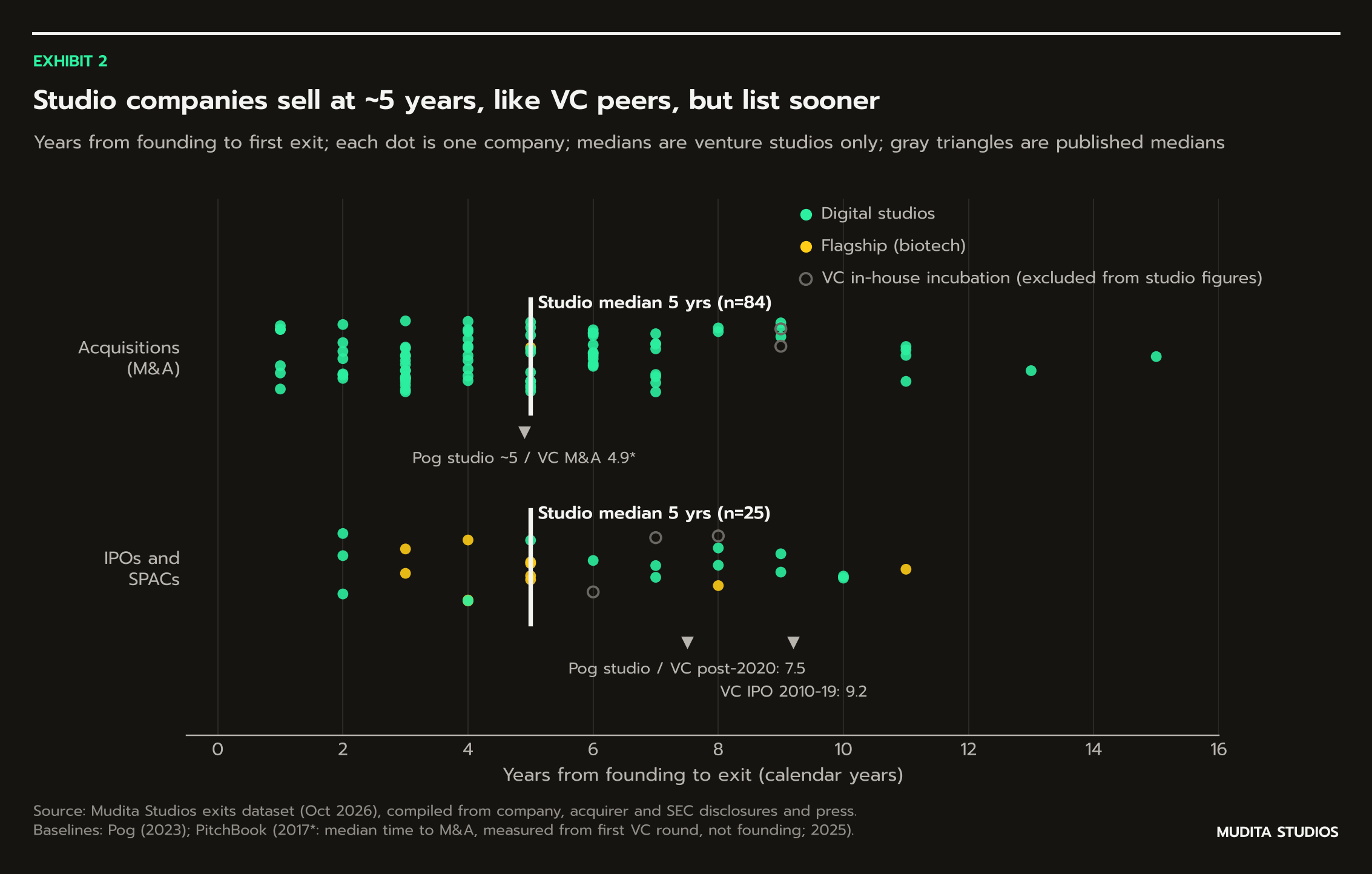
Exhibit 2 plots every exit by the number of years from founding. Acquisitions cluster tightly: the median is 5 years, the middle half fall between 3 and 6 years, and 63% close within 5 years. That matches Pog's "about 5 years." It also roughly matches PitchBook's 4.9-year median for VC-backed acquisitions, which is measured from the first VC round. Measured from founding, as ours is, the VC figure would be somewhat longer. On M&A timing, studios look like the rest of venture, not faster. This needs to be said plainly. PitchBook-NVCA data show that in 2024 more than 70% of exiting VC-backed companies had raised no further than Series A. Selling early is now normal across venture.
Listings are where studios stand out. The median studio IPO or SPAC came 5 years after founding, against PitchBook's 7.5 years (after 2020) and 9.2 years (2010 to 2019) for VC-backed companies. Different periods have very different IPO markets, so Exhibit 3 compares each IPO with Jay Ritter's median age of US VC-backed tech IPOs (or of life-science IPOs, for Flagship) in the same year.
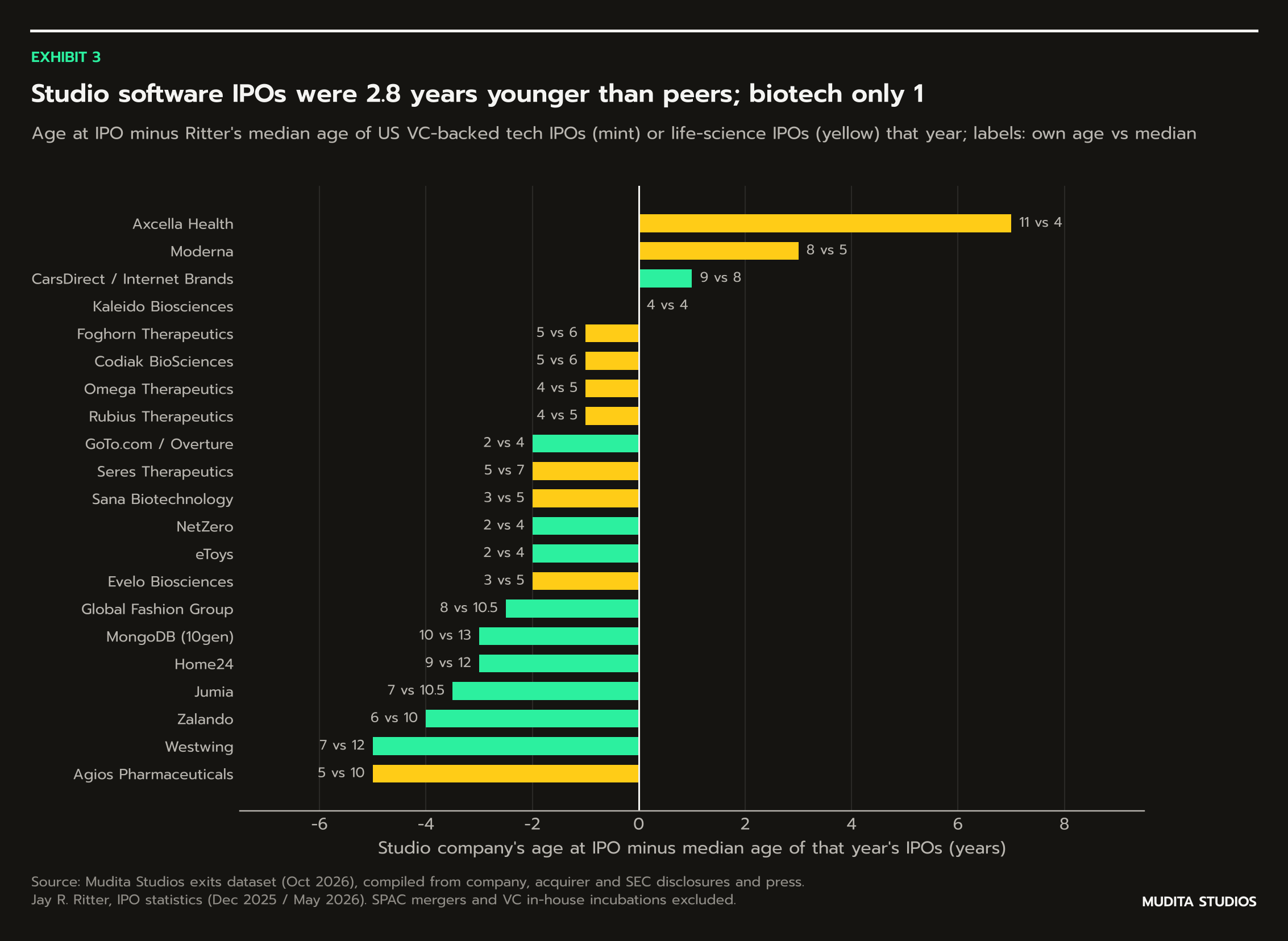
9 of the 10 software IPOs were younger than that year's median VC-backed tech IPO, by a median of 2.8 years. Westwing listed at 7 against a median of 12, Zalando at 6 against 10, and MongoDB at 10 against 13. Flagship's biotech IPOs were only about a year younger than the median life-science IPO, and life-science companies already list young (Ritter's 2001–2025 median age is 6). The speed advantage is therefore real for software listings and small for biotech.
04
3. 96% of buyers were operating companies
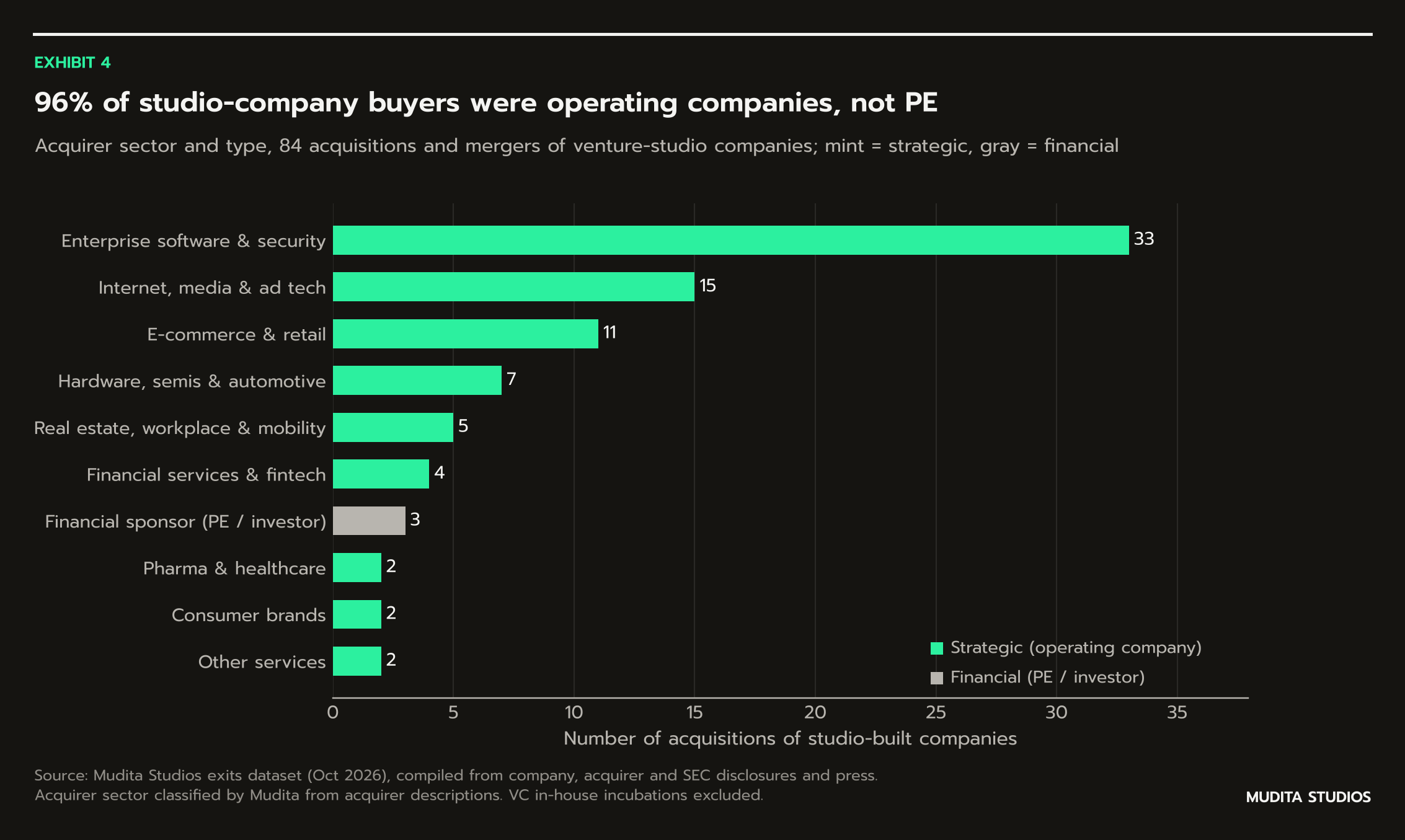
Exhibit 4 classifies the 84 acquirers. Only three were financial buyers: Temasek (Sygnia), Spectrum Equity (Bitly) and Cuadrilla Capital (Chartbeat). The rest were operating companies buying a capability next to their core business. Cisco bought Portshift. Elastic bought Cmd. Atlassian bought Cycle. Criteo bought Gradient. Nike bought TraceMe. Take-Two bought Playdots. Lattice and STMicroelectronics bought TandemLaunch computer-vision companies. Enterprise software and security companies made up 39% of buyers. In three cases the buyer was itself a studio-built company: Spendesk bought Okko and Yousign bought Canyon (both Hexa companies), and Managed by Q (Prehype) bought Hexa's Hivy.
For a corporate acquirer, this makes studios look like an outsourced R&D pipeline. Studios test a narrow thesis cheaply, take it to product-market fit, and offer it to operating companies that want the capability without building it themselves. The 75 acquired studio companies with known funding had raised a median of just $14 million before they were sold ($24 million for the deals with a public price). That is a size a corporate development team can buy without a board fight. Even so, a corporate partnership does not guarantee the partner will buy. Pioneer Square Labs built Genba in a joint studio with Fortive, and RealWear, not Fortive, acquired it.
05
4. The disclosed deals look capital-efficient, but most deals aren't disclosed
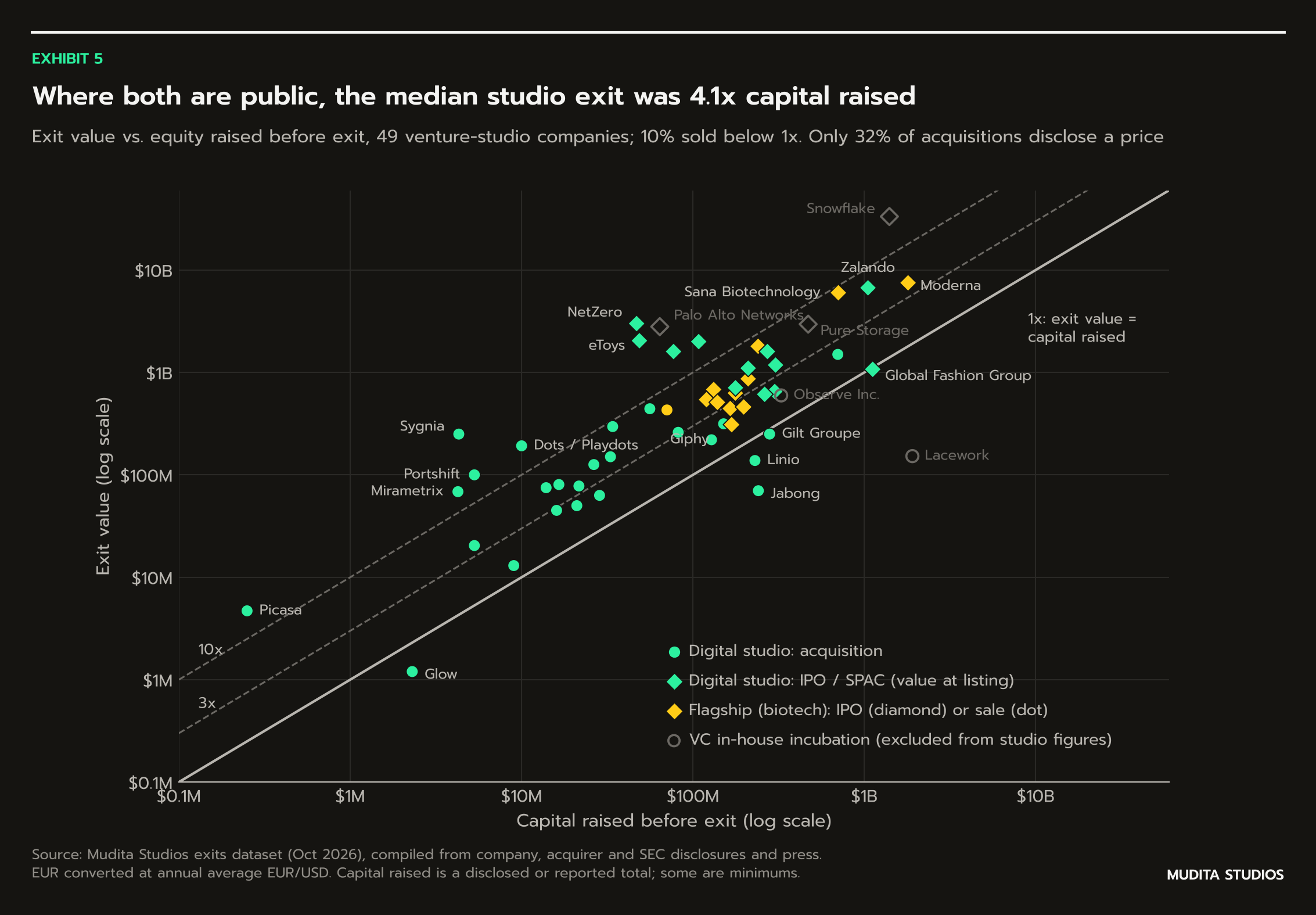
If studios are built to be acquired, the case for them depends on capital efficiency: how much of the exit value was needed to produce it. Exhibit 5 compares exit value with the equity raised before the exit for the 49 studio companies where both are public. The median company exited at 4.1x the capital it had raised. 65% reached 3x or more, 18% reached 10x or more, and 10% (5 companies) sold below 1x. For acquisitions alone the median was 3.7x (n=26). The typical disclosed acquisition took about $24 million of capital and sold for $113 million. Several small exits were efficient: Sygnia sold to Temasek for a reported $250 million after a single $4.3 million seed round, and Mirametrix sold to Lattice for $68.5 million after about $4 million.
PitchBook reports that 70% of VC-backed exits since 2022 were valued below the capital invested. Our 10% looks far better, but the two figures are not comparable. Only 32% of the acquisitions in our data disclose a price, and the deals that go undisclosed are usually small. We stress-tested this. If every undisclosed exit with known capital had returned exactly 1x, the median multiple across all 98 such exits would fall to 1.0x. If they had returned 0.5x, 55% of all exits would be below capital raised. Either way, only about a third of studio exits (33%) are documented at 3x or better. The capital-efficiency argument is plausible, but on public data it is not proven.
Two more caveats apply. Multiples on exit value are not studio returns: we do not observe studio ownership at exit or liquidation preferences. Studio equity also varies widely, from a median of 17% in PitchBook deals to a 34% average in GSSN's self-reported survey. And exits where the studio owned a lot and raised little (Sygnia, Portshift, Dots, Mirametrix) are exactly where the structural argument is strongest and the disclosure is weakest.
06
5. Many exits went bad later
Table 2 lists the notable down-exits. Jabong sold to Flipkart for $70 million after about $240 million had gone in. Giphy was bought by Facebook for $315 million (the price in the UK CMA's decision; about $400 million was reported) and sold to Shutterstock for $53 million after the CMA ordered the sale. WeWork resold Managed by Q for a reported 11% of what it paid. In biotech, 6 of Flagship's 11 IPOs from 2015 to 2021 (Rubius, Evelo, Kaleido, Axcella, Codiak and Omega) were later liquidated or went bankrupt, and Sana and Foghorn trade more than 50% below their IPO prices. Of the 109 exits, 26 carry one of these flags.
The lesson for "exit by design": a sale is a liquidity event for the studio, not proof of value created. Several studio IPOs and SPACs (eToys, Heliogen, GFG, BARK) handed the downside to public investors.
07
What this means
Our data support three parts of the "built to be acquired" thesis and leave the fourth unproven.
- Focused theses. Studio companies are bought by operating companies in adjacent categories (96% strategic). This is consistent with companies designed around a buyer's gap.
- Clean, small cap tables. Companies that sold had raised a median of $14 million. That keeps preference stacks small, so a $100 million–$200 million sale can return real money to common shareholders.
- Strategic-buyer alignment. Buyers are concentrated in software, security, internet and commerce, and several were themselves studio companies.
- Capital efficiency and outperformance: not proven. The disclosed deals are efficient (median 4.1x), but they are a minority. Selling at about 5 years is no faster than VC. The one independent comparison, Malyy & Pog (2024), finds studio deals exit less often than pre-seed VC deals (24% vs 38%), with a similar modelled IRR (17%).
So the honest version of the thesis is about structure, not proven outperformance. Studios are built to be bought, and when they are, it tends to happen at a size and price that suits corporate buyers. For corporate innovation leaders, a studio is a way to buy validated capabilities that need little capital. For LPs, the open question is which share of studio exits never disclose a price, and what those deals returned.
Table 1: 14 of the 15 largest venture-studio exits were listings, and four of them later failed
| # | Company | Studio | Founded | Exit | Yrs | Type | Buyer / venue | Exit value | Raised before exit | Multiple | What happened next |
|---|---|---|---|---|---|---|---|---|---|---|---|
| 1 | Moderna | Flagship Pioneering | 2010 | 2018 | 8 | IPO | Nasdaq listing | $7.5B | $1.8B | 4.2x | COVID-19 vaccine maker; still listed |
| 2 | Zalando | Rocket Internet | 2008 | 2014 | 6 | IPO | Frankfurt Stock Exchange | $6.7B | $1.1B | 6.4x | Still listed; acquired ABOUT YOU (2025) |
| 3 | Sana Biotechnology | Flagship Pioneering | 2018 | 2021 | 3 | IPO | Nasdaq listing | $6.0B | $706M | 8.5x | Shares ~88% below $25 IPO price by Apr 2026 |
| 4 | NetZero | Idealab | 1997 | 1999 | 2 | IPO | NASDAQ listing | $3.0B | $47M | 64.0x | Merged with Juno into United Online (2001) |
| 5 | eToys | Idealab | 1997 | 1999 | 2 | IPO | NASDAQ listing | $2.0B | $49M | 41.9x | Chapter 11 in March 2001; delisted |
| 6 | Heliogen | Idealab | 2013 | 2021 | 8 | SPAC | Athena Technology Acquisition Corp. (NYSE) | $2.0B | $108M | 18.5x | Delisted from NYSE 2023; sold to Zeo Energy in 2025 for ~$10M in stock |
| 7 | Rubius Therapeutics | Flagship Pioneering | 2014 | 2018 | 4 | IPO | Nasdaq listing | $1.8B | $240M | 7.5x | Liquidated 2023 at a ~$15M market value |
| 8 | Hims & Hers | Atomic | 2017 | 2021 | 4 | SPAC | Oaktree Acquisition Corp. (NYSE) | $1.6B | $272M | 5.9x | Still NYSE-listed (2026) |
| 9 | BarkBox / BARK | Prehype | 2011 | 2021 | 10 | SPAC | Northern Star Acquisition Corp. (NYSE) | $1.6B | $77M | 20.8x | Take-private proposals at $0.90-$1.10/share in 2026 were not pursued |
| 10 | Lazada | Rocket Internet | 2012 | 2016 | 4 | Acquisition (controlling stake) | Alibaba Group | $1.5B | $700M | 2.1x | Rocket sold remaining 8.8% to Alibaba for $276M in 2017 (implied $3.15B) |
| 11 | MongoDB (10gen) | AlleyCorp | 2007 | 2017 | 10 | IPO | Nasdaq listing | $1.2B | $303M | 3.9x | Still listed; acquired Voyage AI (2025) |
| 12 | Energy Vault | Idealab | 2017 | 2022 | 5 | SPAC | Novus Capital Corp. II (NYSE) | $1.1B | $210M | 5.2x | Fell below $1 in 2025 and regained NYSE compliance |
| 13 | Jumia | Rocket Internet | 2012 | 2019 | 7 | IPO | NYSE listing | $1.1B | n/d | n/d | Rocket sold its entire stake in 2020; Jumia later raised more equity at lower prices |
| 14 | Global Fashion Group | Rocket Internet | 2011 | 2019 | 8 | IPO | Frankfurt Stock Exchange | $1.1B | $1.1B | 1.0x | Shares ~90% below IPO price by Oct 2026; Lamoda sold 2022 for EUR95M |
| 15 | Omega Therapeutics | Flagship Pioneering | 2017 | 2021 | 4 | IPO | Nasdaq listing | $866M | $210M | 4.1x | Chapter 11 Feb 2025; assets sold to a Flagship affiliate for ~$14M |
Source: Mudita Studios exits dataset (venture studios only; VC in-house incubations are in Table 4). IPO values are market capitalization at the offer price where available (NetZero: first-day close). SPAC values are announced enterprise values. Capital raised for Zalando, BARK, Lazada, Energy Vault, Omega and GFG is a documented minimum.
Table 2: Notable down-exits. Five companies sold for less than they raised, and eight Flagship IPOs later failed or fell more than half
| Company | Studio | Exit | Exit value | Raised before exit | Multiple | Pattern | What happened |
|---|---|---|---|---|---|---|---|
| Jabong | Rocket Internet | 2016 Acquisition (Flipkart / Myntra) | $70M | $241M | 0.29x | sold below capital raised; shut after exit | Walmart impaired the Jabong trade name by $293M (2019); site shut 2020 |
| Glow | Pioneer Square Labs | 2021 Acquisition (assets) (Libsyn) | $1.2M | $2.3M | 0.52x | sold below capital raised | |
| Linio | Rocket Internet | 2018 Acquisition (Falabella) | $138M | $230M | 0.60x | sold below capital raised | Falabella shut Linio Mexico in 2024 |
| Gilt Groupe | AlleyCorp | 2016 Acquisition (Hudson's Bay Company) | $250M | $280M | 0.89x | sold below capital raised; resold at a fraction | Resold to Rue La La in 2018 for a reported well below $100M |
| Global Fashion Group | Rocket Internet | 2019 IPO (Frankfurt) | $1.1B | $1.1B+ | 0.96x | at or below capital raised; listed, later fell >50% | Shares ~90% below IPO price by Oct 2026 |
| Hysolate | Team8 | 2022 Acquisition (Perception Point) | n/d | $33M | n/d | sold below capital raised (reported) | Sold for less than the capital raised, per Calcalist |
| Giphy | betaworks | 2020 Acquisition (Facebook / Meta) | $315M | $151M | 2.09x | resold at a fraction | CMA forced divestiture; Meta sold it to Shutterstock for $53M in 2023 |
| Managed by Q | Prehype | 2019 Acquisition (WeWork) | $220M | $128M | 1.72x | resold at a fraction | WeWork resold it to Eden in 2020 for a reported $25M |
| Rubius Therapeutics | Flagship Pioneering | 2018 IPO (Nasdaq) | $1.8B | $240M | 7.50x | failed after exit | Liquidated 2023 at a ~$15M market value |
| Omega Therapeutics | Flagship Pioneering | 2021 IPO (Nasdaq) | $866M | $210M | 4.12x | failed after exit | Chapter 11 Feb 2025; assets sold to a Flagship affiliate for ~$14M |
| Evelo, Kaleido, Axcella, Codiak | Flagship Pioneering | 2018–2020 IPOs (Nasdaq) | $309M–$510M | $139M–$198M | 1.8x–3.7x | failed after exit | Dissolved, wound down or Chapter 11, 2022–2024 |
| Sana, Foghorn | Flagship Pioneering | 2020–2021 IPOs (Nasdaq) | $6.0B; $628M | $706M; $177M | 8.5x; 3.6x | listed, later fell >50% | Sana ~88% and Foghorn ~58% below IPO price (2026) |
| Heliogen | Idealab | 2021 SPAC (NYSE) | $2.0B | $108M | 18.5x | failed after exit | Delisted 2023; sold to Zeo Energy for ~$10M in stock (2025) |
| eToys | Idealab | 1999 IPO (NASDAQ) | $2.0B | $49M | 41.9x | failed after exit | Chapter 11 in March 2001 |
Source: Mudita Studios exits dataset, venture studios only. The full list has 28 companies. GFG's capital raised is a minimum (over €1B by 2014), so its true multiple is lower than shown.
Table 3: A quarter of claimed studio exits were not studio-built; the best-known examples
| Company | Claimed studio | Exit | Why excluded |
|---|---|---|---|
| Dollar Shave Club | Science Inc | 2016 acquisition (Unilever, ~$1B reported) | Incubation claim is self-reported only; press lists Science as an investor; founder-originated |
| Bird | Science Inc | 2021 SPAC (Switchback II) | Science's own portfolio tags it as a fund investment, not a studio company |
| Talon Cyber Security | Team8 | 2023 acquisition (Palo Alto Networks) | Team8 was a seed investor; founders started it independently |
| Dig Security | Team8 | 2023 acquisition (Palo Alto Networks) | Team8 led the seed round; founders say they started it themselves |
| AppDynamics | Greylock | 2017 acquisition (Cisco, $3.7B) | Primary accounts show a Series A investment, not incubation |
| Lessonly | High Alpha | 2021 acquisition (Seismic) | Launched in 2013, before High Alpha existed (2015) |
| HelloFresh | Rocket Internet | 2017 IPO (Frankfurt) | Rocket was an early majority investor; founding role not established |
| LowerMyBills.com | Idealab | 2005 acquisition (Experian, $330M) | Founder-built; Idealab role not established |
| Oscar Health | Thrive Capital | 2021 IPO (NYSE) | Co-founded by Thrive's founder personally; Thrive was an investor |
| Delivery Hero | Rocket Internet | 2017 IPO (Frankfurt) | Not Rocket-built; Rocket built foodpanda and sold it to Delivery Hero (2016) |
Source: Mudita Studios exits dataset, which records all 37 exclusions with reasons. Delivery Hero was screened out before research and is not counted in the 37.
Implications
What this means for corporate innovation leaders and LPs
- Corporate acquirers can treat studios as a pipeline of validated capabilities that have raised little capital before sale.
- Verify attribution before citing a studio's exits. A quarter of claimed exits in our data were not studio-built.
- Ask studios which exits never disclosed a price, and what those deals returned.
- Treat a sale as a liquidity event for the studio, and track what happens to the company after exit.
Appendix
Method, data and sources
Note: VC in-house incubations, reported separately
Some VC firms incubate companies in their own offices, with a partner serving as interim CEO. This is studio-like, but it is a different model from a dedicated venture studio, because these firms mostly invest in outside startups. We verified five such exits. They are excluded from every studio figure above, and in Exhibits 2 and 5 they appear only as muted outlines.
Table 4: Five VC in-house incubations: three large IPOs, one sibling sale and one deep down-exit
| Company | VC firm | Founded | Exit | Yrs | Type | Buyer / venue | Exit value | Raised before exit | Multiple | What happened next |
|---|---|---|---|---|---|---|---|---|---|---|
| Palo Alto Networks | Greylock | 2005 | 2012 | 7 | IPO | NYSE listing | $2.8B | $64M | 43.8x | Became a large-cap acquirer (CyberArk, ~$25B, 2025-26) |
| Pure Storage | Sutter Hill Ventures | 2009 | 2015 | 6 | IPO | NYSE listing | $3.0B | $470M | 6.3x | Closed below $17 IPO price on day one; rebranded Everpure 2026 |
| Snowflake | Sutter Hill Ventures | 2012 | 2020 | 8 | IPO | NYSE listing | $33.3B | $1.4B | 23.8x | Closed day one at ~$70B; later acquired Observe (2026) |
| Lacework | Sutter Hill Ventures | 2015 | 2024 | 9 | Acquisition | Fortinet | $152M | $1.9B | 0.08x | Valued at $8.3B in 2022 funding round |
| Observe Inc. | Sutter Hill Ventures | 2017 | 2026 | 9 | Acquisition | Snowflake (itself a Sutter Hill incubation) | $596M | $327M | 1.8x |
Source: Mudita Studios exits dataset. Pure Storage's value is its first-day closing market capitalization. Snowflake's is its market capitalization at the $120 offer price. Lacework's is the cash consideration in Fortinet's SEC filing; Observe's is the preliminary purchase consideration in Snowflake's SEC filing.
This model produced the largest outcome in the whole dataset (Snowflake) and one of the worst (Lacework raised about $1.9 billion and sold for $152 million). The median exit came at 8 years, and the median multiple was 6.3x, but five exits are too few to generalise from.
Methodology and limitations
Dataset construction. We gathered candidate exits from each studio's own portfolio pages (looking for "Acquired", "IPO" or "Studio" tags at High Alpha, Pioneer Square Labs, Hexa, Expa, Science Inc., AlleyCorp and Atomic), from the betaworks and Idealab company lists, from the Venture Studio Index list of large exits, and from targeted searches. For each candidate we researched the founding year, the studio's actual role, the exit details, the price and the capital raised before the exit, recording a source for each. Every record was then reviewed by hand. A company counts as studio-built only if a source says the studio founded, co-founded, incubated or launched it, rather than only invested in it. VC in-house incubations meet that test but are reported separately (Table 4). Of the 109 studio exits, 22 rest only on the studio's own description of its role (common for High Alpha, Hexa and Pioneer Square Labs), and two are contested (Giphy, TweetDeck). Excluding all 24 leaves 85 exits, with 75% M&A, a 5-year median to acquisition and a 4.2x median multiple.
Definitions. Years to exit is the exit calendar year minus the founding calendar year, the same convention Ritter uses. The exit is the company's first liquidity event: IPO, SPAC merger, acquisition, merger, or sale of a majority or controlling stake. Exit value is the disclosed acquisition price, or the market capitalization at the IPO offer price, or the announced enterprise value for SPACs. Some values are lower bounds (Picasa, Bitly) or reported estimates, and each record notes which. Capital raised is equity raised before the exit; in some cases it is a documented minimum, which pushes the multiple up. Euro amounts are converted at the annual-average EUR/USD rate for the exit year. Buyer type and sector are our own classifications, made from acquirer descriptions.
Limitations. (1) Disclosure bias: only 32% of acquisitions disclose a price, so the multiples describe the disclosed minority (see the stress test in Section 4). (2) Survivorship and selection: studios publicise wins, and silent shutdowns are not exits, so the dataset says nothing about exit rates. For that, see Malyy & Pog (24% studio vs 38% pre-seed VC). (3) Coverage: the dataset over-represents studios that publish their portfolios. Hexa's own count of exits differs from CB Insights (6) and Tracxn (11), and we could not verify Founders Factory, Wavemaker or Atomic beyond Hims and TalkIQ. (4) Baselines are not like-for-like: PitchBook's 4.9-year M&A median is measured from first financing, not founding. Ritter's medians cover US-listed IPOs, while Rocket's listings were in Frankfurt. (5) No ownership data: exit multiples are company-level, not studio returns.
The full dataset, including every exit, its sources and the excluded attributions, is available on request.
Sources
Every exit in the dataset is backed by primary sources: acquirer and company announcements, SEC filings, studio portfolio pages and contemporary press. The full source list, with a reliability rating for each source, is available on request. Key outside sources:
- Max Pog, Big Startup Studios Research 2023 (Sep 2023), inniches.com/startup-studios-research. Studio-industry dataset (industry survey).
- Malyy & Pog, Big Venture Studio Research 2024 (Dec 2024), inniches.com/big-venture-studio-research. PitchBook deals, 38 of them from studios (independent data).
- PitchBook, "Which startup is next in line for an IPO?" (Jun 2017): 4.9-year median time to M&A, 8.3 years to IPO (independent data).
- PitchBook, "VC fund distributions will rebound in 2025" (Jan 2025): 9.2-year median to IPO, 2010–2019 (independent data).
- PitchBook, "More startups are exiting at a loss than at any point since 2009" (2024): 70% of exits below capital invested since 2022 (independent data).
- PitchBook-NVCA Venture Monitor Q4 2024 (Jan 2025): more than 70% of 2024 exits came from companies that had raised no further than Series A (independent data).
- Jay R. Ritter, IPO statistics: median age of IPOs and VC-backed IPO statistics (Dec 2025 / May 2026), site.warrington.ufl.edu/ritter (independent academic data).
- GSSN, Disrupting the Venture Landscape (Nov 2020), via Vault Fund: 53% vs 21% IRR, 14 studios reporting (self-reported; cited only as context).
- UK CMA Giphy decision (2023); Shutterstock–Giphy announcement (May 2023); Fortinet 10-Q (Lacework); Take-Two 8-K (Playdots); Libsyn 8-K (Glow).