Mudita Studios ResearchThe Studio Series
The Founder–Studio Equity Equation
What a venture studio's stake really costs a founder, and how much better the odds have to be to pay for it
Executive summary
We simulated founder ownership through Series A on five paths, from angels and accelerators to venture studios, to show what a studio's stake really costs. The result is a simple break-even test for founders, studios and corporate venture builders.
- 01
39%
founder ownership at Series A after giving a studio 30% at formation
A 30% stake costs about 9 points
That compares with 49% on a bootstrapped-plus-angels path, 51% after Y Combinator and 53% after Techstars, in a 20,000-draw simulation on Carta round data.
- 02
1.26x
lift in Series A odds a 30% studio stake must deliver to break even
The break-even is steep
A 20% stake needs 1.10x and a 40% stake 1.47x, compared with the angel path. Each extra 10 points of stake requires roughly 13–17% better odds.
- 03
$9.5M
expected founder equity at Series A with a 30% studio stake and no studio advantage
With no advantage, every studio path loses
The angel path gives $11.7M. The only independent deal-level study found studio deals exiting less often than pre-seed VC (24% vs 38%), on just 38 studio deals.
- 04
34%
largest studio stake that breaks even on the best independent speed data
Which evidence you believe decides the answer
On the studio industry's self-reported success rates, stakes up to about 49% break even. The speed data comes from one studio-industry dataset that is not peer-reviewed.
- 05
8.4%
Series A ownership of a corporate-studio founder who starts at 15%
Equity alone cannot pay corporate-studio founders
Matching the angel path would need almost sixfold better odds of reaching Series A. The 10–20% formation stake is anecdotal, since no corporate studio we looked at publishes its terms.
01
The wrong comparison
The usual founder objection is "the studio wants 30% and YC wants 7%." That comparison is wrong. A studio's stake usually includes the pre-seed capital, the first hires and months of product and go-to-market work. A founder on the traditional path pays for those with an angel round, an accelerator or both. The right question is how much the founder owns at the milestone that matters, Series A, and how likely they are to get there.
Our cap-table simulator follows founding-team ownership from formation through seed, Series A and Series B along five paths:
- (a) bootstrapped, then an angel or pre-seed SAFE, then seed and Series A;
- (b) Y Combinator on its current published deal: $125K for a fixed 7%, plus a $375K uncapped MFN SAFE;
- (c) Techstars on its 2025 terms: a $20K CEA for 5% common, plus a $200K uncapped MFN SAFE;
- (d) a studio taking 20%, 30% or 40% at formation, plus a version calibrated to Hexa's published model (30% after a seed that sells 15%);
- (e) a corporate-studio co-founded venture.
Every priced round draws its dilution from Carta's latest distribution: 1,133 US software rounds in the six months to July 2026. Medians are 18% at seed, 18% at Series A and 12% at Series B, with interquartile ranges of 12–22%, 11–21% and 8.6–16.4%. The angel round uses Carta's SAFE benchmark for $500K–$999K raises (median 12.0%, IQR 7.3–18.9%). The employee pool starts at 12.1% at seed (Carta median) and is topped up to Carta-anchored levels at each later round. The full method is under Methodology below.
02
Finding 1: studio founders start lower and never catch up, but the gap is smaller than the headline
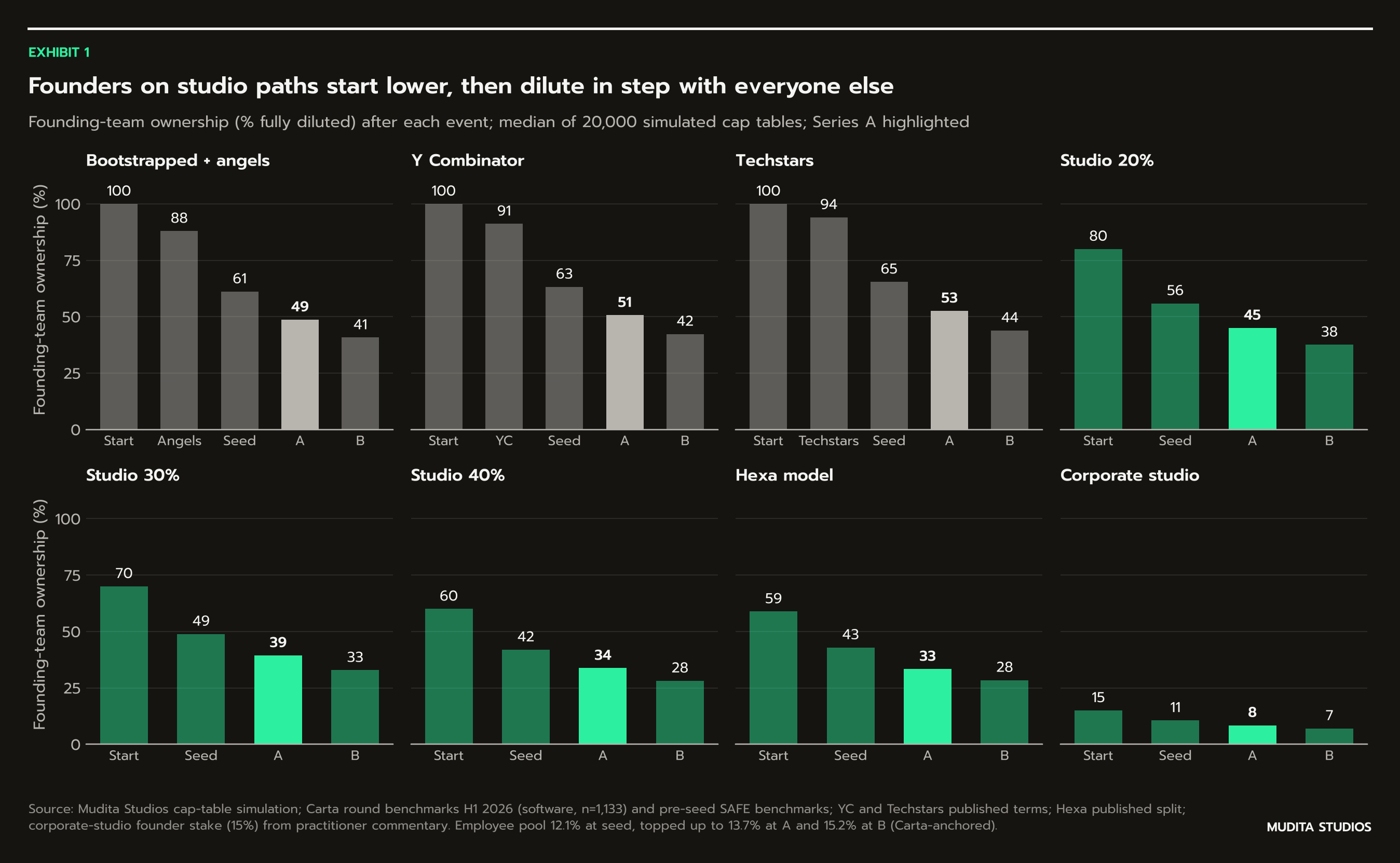
Exhibit 1 shows the founder's slice after each event. Studio founders start lower, then dilute at the same rate as everyone else. The traditional paths lose 6–12 points to the accelerator or angel round; the studio founder paid at formation. At seed, the angel-path founder holds 61% and the 30%-studio founder holds 49%.
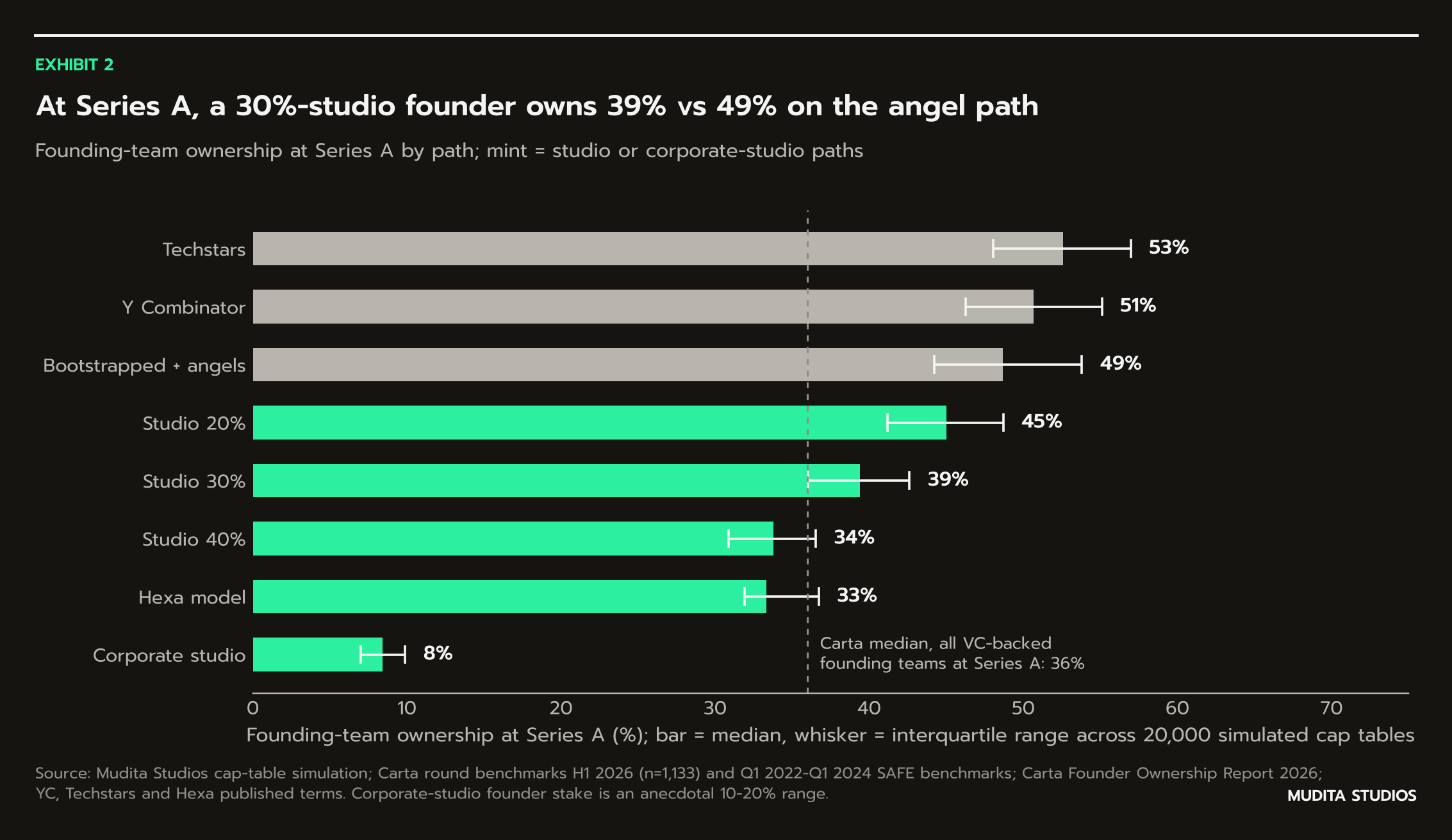
At Series A (Exhibit 2), the 30% studio founder sits at 39% (IQR 36–43%), about 9 points behind the angel path. A 20% studio costs 4 points; a 40% studio costs 15. Hexa's published model leaves founders at about 33%. At 40% or more, a founder is below Carta's 36% median for all VC-backed founding teams at Series A.
Carta's observed medians (56% after seed, 36% at A) sit below our angel path (61%, 49%) because real companies stack SAFEs and raise bridges. That extra dilution hits every path alike, so the comparisons hold, but the absolute numbers are best-case.
Table 1: A 30% studio stake leaves founders about 9 points below the angel path at Series A
| Path | After SAFE / program | After seed | At Series A (median) | At Series A (IQR) | At Series B (median) |
|---|---|---|---|---|---|
| Bootstrapped + angels | 88.0% | 61.1% | 48.7% | 44.2–53.8% | 40.7% |
| Y Combinator | 91.1% | 63.2% | 50.7% | 46.3–55.1% | 42.3% |
| Techstars | 94.0% | 65.4% | 52.6% | 48.1–57.0% | 43.9% |
| Studio 20% | 80.0% | 55.9% | 45.0% | 41.2–48.7% | 37.5% |
| Studio 30% | 70.0% | 48.9% | 39.4% | 36.0–42.6% | 32.8% |
| Studio 40% | 60.0% | 41.9% | 33.8% | 30.9–36.5% | 28.2% |
| Hexa model | 58.8% | 42.9% | 33.3% | 31.9–36.7% | 28.4% |
| Corporate studio | 15.0% | 10.6% | 8.4% | 7.0–9.9% | 7.0% |
Source: Mudita Studios cap-table simulation; Carta round benchmarks H1 2026 and SAFE benchmarks Q1 2022–Q1 2024; YC, Techstars and Hexa published terms. The full table, with 2024-dilution and pool-rule sensitivities, is available on request.
03
Finding 2: the break-even is a ratio, and it is steep
Expected founder value at Series A is ownership × probability of reaching Series A × the Series A valuation. Hold the valuation constant (we found no evidence that studio companies price differently at A) and the break-even becomes a ratio. The studio has to multiply the founder's odds by the angel-path ownership divided by the studio-path ownership. Pools and later rounds dilute both paths equally, so the multiplier is roughly (1 − angel dilution) ÷ (1 − studio stake).
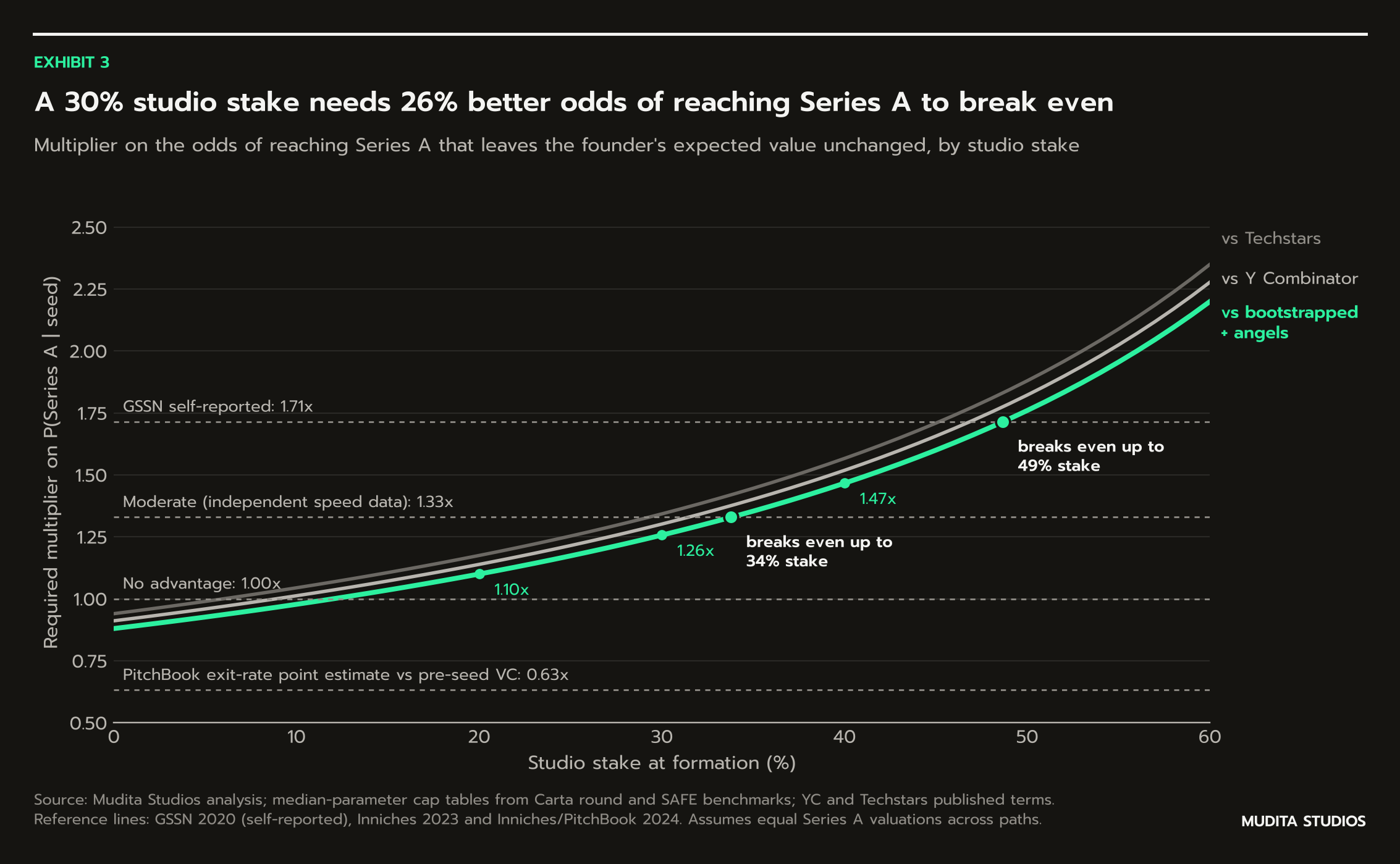
Exhibit 3 plots that curve. Taking Carta's "normal year" graduation rate of 30% as the base, a 30% stake has to lift the odds of reaching Series A to about 38%, or 1.26x. A 40% stake needs 44% (1.47x) and a 50% stake needs 53% (1.76x). Each extra 10 points of stake requires roughly 13–17% better odds. Against Y Combinator or Techstars the bar is a little higher (1.30x and 1.34x at 30%), because those programs cost the founder less than an angel round does.
04
Finding 3: which evidence you believe decides the answer
We ran the comparison under three evidence scenarios (Exhibit 4).
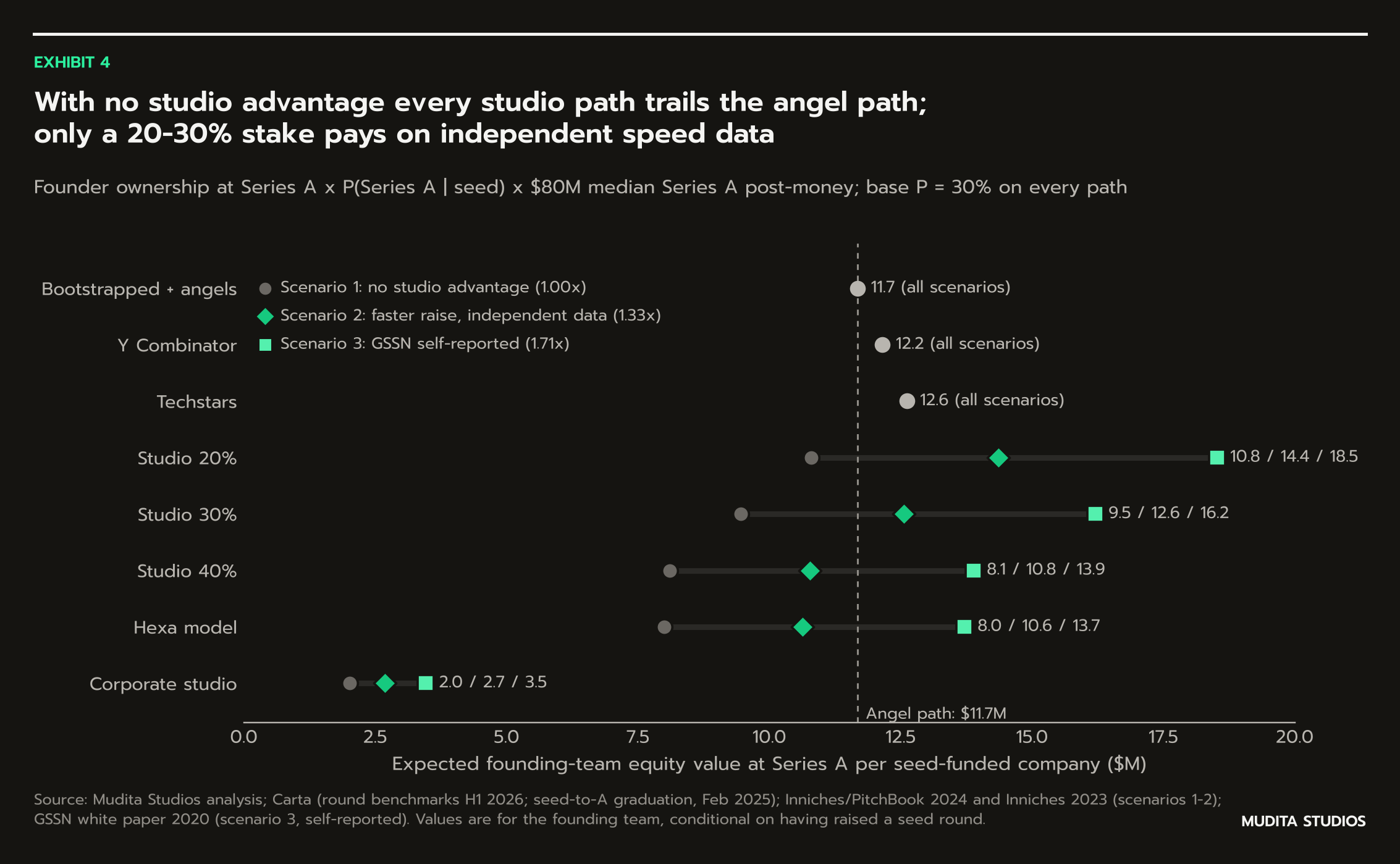
Scenario 1 (pessimistic): no studio advantage. The only independent, deal-level comparison we found is Malyy and Pog's analysis of 2,246 realised pre-seed deals in PitchBook (December 2024). Studio-backed deals exited 24% of the time, against 38% for pre-seed VC. Taken at face value, that is a 0.63x multiplier, not an advantage. Two caveats cut the other way. The studio sample is only 38 deals from 23 studios. And the same study found studios ahead of accelerators, which exited 14% of the time. We therefore model this scenario as no advantage (1.00x). On that basis every studio path trails: at 30% the founder's expected equity at Series A is $9.5M against $11.7M on the angel path. Only a stake below about 12%, roughly what an angel round costs, breaks even.
Scenario 2 (moderate): studios help founders raise faster. The independent evidence here is about speed, not survival. Pog's 2023 analysis of the Venture Studio Index and Crunchbase found studio companies reached seed in 1.49 years vs 3.03 and Series A in 2.75 years vs 4.68. That implies 1.26 vs 1.65 years from seed to Series A. Pog is a studio-industry researcher and the work is not peer-reviewed. To turn speed into odds, we used a constant-hazard model: a company that needs 24% less time to reach Series A faces 24% less exposure to failure on the way. At a 30% base, that gives 1.33x. Stakes up to about 34% then break even against the angel path, 31% against YC and 29% against Techstars. We found no independent source showing that studio companies survive better than VC-backed ones, so this scenario includes no survival bonus beyond speed.
Scenario 3 (optimistic): the studio industry's own numbers. The Global Startup Studio Network's 2020 white paper reports that 72% of studio companies that raise a seed reach Series A, against 42% of traditional startups (a Crunchbase figure from 2018). That is a 1.71x multiplier. It would justify stakes up to about 49%. These are self-reported (258 startups from member studios, with a comparator from a different source and era); we show them because the industry quotes them, not as fact.
Table 2: The largest studio stake that breaks even depends on which evidence you believe
| Evidence scenario | Multiplier on Series A odds | Max stake vs angel path | vs YC | vs Techstars |
|---|---|---|---|---|
| PitchBook exit-rate point estimate (vs pre-seed VC) | 0.63x | none | none | none |
| 1: No studio advantage | 1.00x | 12% | 9% | 6% |
| 2: Faster raise (independent speed data) | 1.33x | 34% | 31% | 29% |
| 3: GSSN self-reported | 1.71x | 49% | 47% | 45% |
Source: Mudita Studios analysis; Inniches/PitchBook 2024; Inniches 2023; GSSN 2020 (self-reported); Carta. Base P(Series A given seed) = 30%. Full break-even and Scenario 2 sensitivity tables are available on request.
Scenario 2 is sensitive to the base rate. At 2022's depressed 17% graduation rate, the same speed advantage is worth 1.52x and justifies up to 42%. At GSSN's 42% base it is worth 1.23x and justifies 28%. Speed matters most when it is hardest to raise.
05
What studios actually take, and what they publish
What studios say they take and what deal data shows are far apart. GSSN's 2020 survey put the average stake at 34% at formation (range about 15–80%), and 59% of 123 studios in the 2024 Inniches survey reported 30% or more. Yet in realised pre-seed deals in PitchBook, the median studio stake was 17% (IQR 12–23%). Timing and hybrid accelerator-style studios explain part of the gap. Founders should treat "the studio norm is a third" as a negotiating claim, not a market fact. The same survey found that studios taking under 20% reported higher success rates than those taking 20–30% (p < 0.1).
Very few studios publish their terms. We could find only four sets.
Table 3: Only a handful of studios publish their terms, and none publish fees or vesting in full
| Studio | Published stake | Capital and services | Founder protections | Date |
|---|---|---|---|---|
| Hexa (Paris) | 30% after seed; seed fund ~15% | ~€800K per startup over 12 months, incl. founder salaries; ~30-person support team | Not published | Sep 2024 |
| Alder VC | Founder always >50% before seed | Fixed one-quarter engagement | No reverse vesting, acqui-hire clauses, management fees or preference stacks | Apr 2026 |
| Antler (US Disrupt) | 10% for $250K + $150K uncapped MFN SAFE | Residency; US page now cites $500K–$1M initial commitment | No sprint fee | Jun 2026 (third-party summary) |
| Antler ONE (Europe) | 8.5% for €100K + €100K SAFE/CLA (MFN) | Up to €300K matching at pre-seed | Not stated | Jul 2025 |
Source: Hexa; Alder VC; Antler via rfp.wiki, Silicon Canals and antler.co. All self-reported by the studio.
Table 4: Accelerators take 5–10% fixed, plus an uncapped SAFE worth roughly 1–2 points at seed
| Program | Cash | Fixed equity | Plus | Fees | Terms dated |
|---|---|---|---|---|---|
| Y Combinator | $500K | 7.0% | $375K uncapped MFN SAFE | None | Accessed Oct 2026 |
| Techstars | $220K | 5.0% (common) | $200K uncapped MFN SAFE | None | Apr 2025 |
| Entrepreneurs First | up to $250K | 8.0% | Optional $125K MFN SAFE (third-party platform) | Not stated | May 2024 |
| Antler UK | £210K | 8.5% | £85K convertible note | Not stated | Aug 2025 |
Source: YC, Techstars and EF published terms; Techleap. The full table is available on request.
06
The corporate-studio case
No corporate studio we looked at publishes its terms; the only figure we found is practitioner commentary that founding teams "often" hold 10–20% at formation. At 15%, the founder holds about 8% at Series A. To match the angel path on expected value, the venture would need to raise the odds of reaching Series A almost sixfold, which no evidence supports. For corporate innovation leaders the implication is plain: you are hiring an operator, so the package must work as a job (salary, bonus, and a founder grant topped up at spin-out or the first outside round), not as an equity bet.
07
Practical guidance
For founders: questions to ask a studio
- What exactly does the stake buy? Get cash, salaries, named people and months of work in writing. Hexa's roughly €800K over 12 months is the published benchmark. If the studio puts in no cash of its own, Yoskovitz notes, "every investor will wonder why they're not investing."
- Where will I be after seed and Series A? Run the numbers in this piece. Above a stake of about 28%, founders fall below 50% after seed, the practitioner line that studios such as Alder commit to.
- Is the studio's equity common or preferred, and does it carry a liquidation preference? Alder's example: a 2x preference on $400K of studio money takes $800K off the top of a $10–20M exit.
- Will the studio dilute alongside me, sell down at Series A, or top up my pool? In one practitioner model, the studio sells half its shares in a Series A secondary, which shrinks a stake that downstream investors see as dead weight.
- Can I see the Series A outcomes for the studio's last ten companies? Ask for all ten, not just the winners.
Red flags
- Reverse vesting on founder shares. Standard for employees, not for founding equity (Alder).
- Milestone vesting on the studio's own equity, such as "product-market fit identified." This invites disputes over definitions.
- Fee chargebacks and paybacks. One real offer reviewed by Yoskovitz asked for 35% plus $25K a month through MVP, with no capital invested.
- Management fees, acqui-hire clauses and preference stacks on studio equity.
- Terms that only appear after you have committed time.
For studios: what is a sustainable stake?
The arithmetic says a studio has to earn its stake back in better Series A odds. On the best independent evidence, that supports about 20–30% at formation, provided the studio delivers capital and a team rather than advice. Stakes of 40% and above rely on the self-reported success rates that downstream investors increasingly discount. Three moves make a higher stake defensible:
- Put real cash in, so the stake is capital as well as sweat equity.
- Commit in advance to diluting disproportionately or selling down at Series A.
- Publish your terms, as Hexa, Alder and Antler do.
Implications
What this means for founders, studios and corporate innovation leaders
- Founders should compare ownership at Series A and get in writing the cash, people and months of work a stake buys.
- Ask a studio for the Series A outcomes of all of its last ten companies, including the ones that failed.
- On the best independent evidence, studios can sustain 20–30% at formation when they deliver capital and a team.
- Pay corporate-studio founders as operators, with salary, bonus and a founder grant topped up at spin-out or the first outside round.
Appendix
Method, data and sources
Methodology and limitations
- Engine. The simulator applies each path to share counts. At seed, SAFEs and CEAs convert first into fixed percentages; YC's 7% and Techstars' 5% are diluted by the priced round and the pool increase, as their terms state. Uncapped MFN SAFEs convert at the seed price, assuming no lower-cap SAFE was issued. The pool is then created or topped up in the pre-money, and new money comes in last.
- Simulation. Round dilution and seed valuation are drawn independently (20,000 draws) from piecewise-linear quantile functions through Carta's quartiles. Real rounds are correlated, so the ranges are indicative, not confidence intervals.
- Pool. The total employee pool is 12.1% at seed, then topped up to 13.7% after A and 15.2% after B. These are linear interpolations between Carta's medians of 12.1% at seed and 16.8% at Series C. A practitioner rule (refresh to 10% unallocated) lowers every path by 1–2 points and leaves the comparisons unchanged.
- Value. Value is measured at Series A, conditional on having raised a seed, using Carta's median Series A post-money of $80M for every path. We ignore time value; faster studio companies would gain somewhat from it. We also ignore liquidation preferences, studio fees and founder salaries. Salaries favour studio and corporate paths; fees and preferences hurt them.
- Accelerator odds. YC and Techstars companies are held at the base odds in every scenario. We found no independent graduation data for them, and YC companies may raise at higher valuations. Both points probably understate the accelerator paths.
- Evidence quality. Scenario 1 rests on 38 studio deals. Scenario 2 rests on one studio-industry dataset and a stylised hazard model. Scenario 3 is self-reported. The corporate-studio stake is anecdotal. Carta's percentiles come from US software rounds.
Sources
Full citations with dates, measurement notes and reliability ratings are available on request. Principal sources:
- Carta: VC Fundraising Benchmarks (Jul 2026); How Much Dilution Do Founders Sell (2024 data); State of Pre-Seed Q1 2024; Founder Ownership Report 2026; Seed Option Pool (Jan 2025); Graduation Rate from Seed to Series A (Feb 2025).
- Y Combinator, The YC Deal; Techstars Investment Terms Update (Apr 2025); Entrepreneurs First (May 2024); Antler (antler.co; Silicon Canals; Techleap; rfp.wiki).
- Hexa, "Is Hexa worth 30%?"; Alder VC, "Venture Studio Equity" (Apr 2026).
- Malyy and Pog, Big Venture Studio Research 2024 (Inniches; PitchBook deals and studio survey); Pog, Big Startup Studios Research 2023.
- GSSN, Disrupting the Venture Landscape (Nov 2020; self-reported); Crunchbase News (2018).
- Focused Chaos #88 (Jan 2025) and "Understanding Venture Studio Math" (Oct 2023); TFSF Ventures (Jul 2026; anecdote).