Mudita Studios ResearchThe Studio Series
The Corporate Innovation GraveyardWhy Most Internal Ventures Die, and What Studios Do Differently
We built a dataset of 70 corporate labs, accelerators, venture arms and internal ventures that were shut, sold, spun out or scaled back. Half were gone within five years. The reasons were mostly about the parent company, not the venture.
Executive summary
We traced 70 corporate labs, accelerators, venture arms and internal ventures that were shut, sold, spun out or scaled back. Their short lives were mostly decided by the parent company, which shows innovation leaders what to protect against before they start.
- 01
4.7 yrs
median lifespan of 70 closed corporate innovation units
Half were gone within five years
A typical VC fund runs 10–12 years. Internal ventures died youngest, at a median of 3.8 years, and only 11% of units passed year ten.
- 02
47%
of units closed within two years of a new parent CEO (32 of 68)
New CEOs close their predecessors' bets
Random timing would put roughly 22–29% of closures in that window. Only five reported reasons name new leadership, so the link comes from timing.
- 03
30%
of cases cite budget cuts or restructuring
Budget cuts were the most-cited failure mode
No path back to the core followed at 24% and time-horizon mismatch at 14%. Reported reasons are often spin, so governance and incentive failures are likely under-coded.
- 04
37%
of closures came in downturn years, which are 19% of the window
Closures come in waves
Downturn years averaged 8.7 closures each, against 3.4 in other years. The sample overweights recent, well-covered closures, and the test does not control for that.
- 05
31%
of cases ended with the unit absorbed, sold or spun out as a going concern
Some deaths are graduations, and studios die too
Studios have their own graveyard: 154 of 1,107 had closed by September 2024, and studio-backed deals exited less often than pre-seed VC deals (24% vs 38%).
01
A graveyard with headstones
Corporate innovation units rarely announce their own deaths. The press release for a launch gets a keynote slot. The closure usually surfaces in an internal memo, a layoff filing or a line in an earnings call. To see the pattern, we assembled our own graveyard: 70 named units at 53 parent companies, each with a launch date, a closure date and a reported reason, every one tied to a source (184 sources in all).
The set covers four kinds of unit: 43 internal ventures (new businesses built or bought and run inside the parent, such as GM's Maven, JPMorgan's Finn or Apple's car project), 10 innovation labs and incubators (Walmart's Store No. 8, Microsoft Research Silicon Valley, Xerox PARC), 9 corporate VC units (GE Ventures, BBVA Ventures, BP Ventures) and 8 corporate accelerators (Coca-Cola Founders, Barclays Rise, Telstra's muru-D). For contrast we also logged 22 units that are still running, including Intel Capital (founded 1991), GV (2009) and the Disney Accelerator (2014).
02
Finding 1: The median unit lived 4.7 years
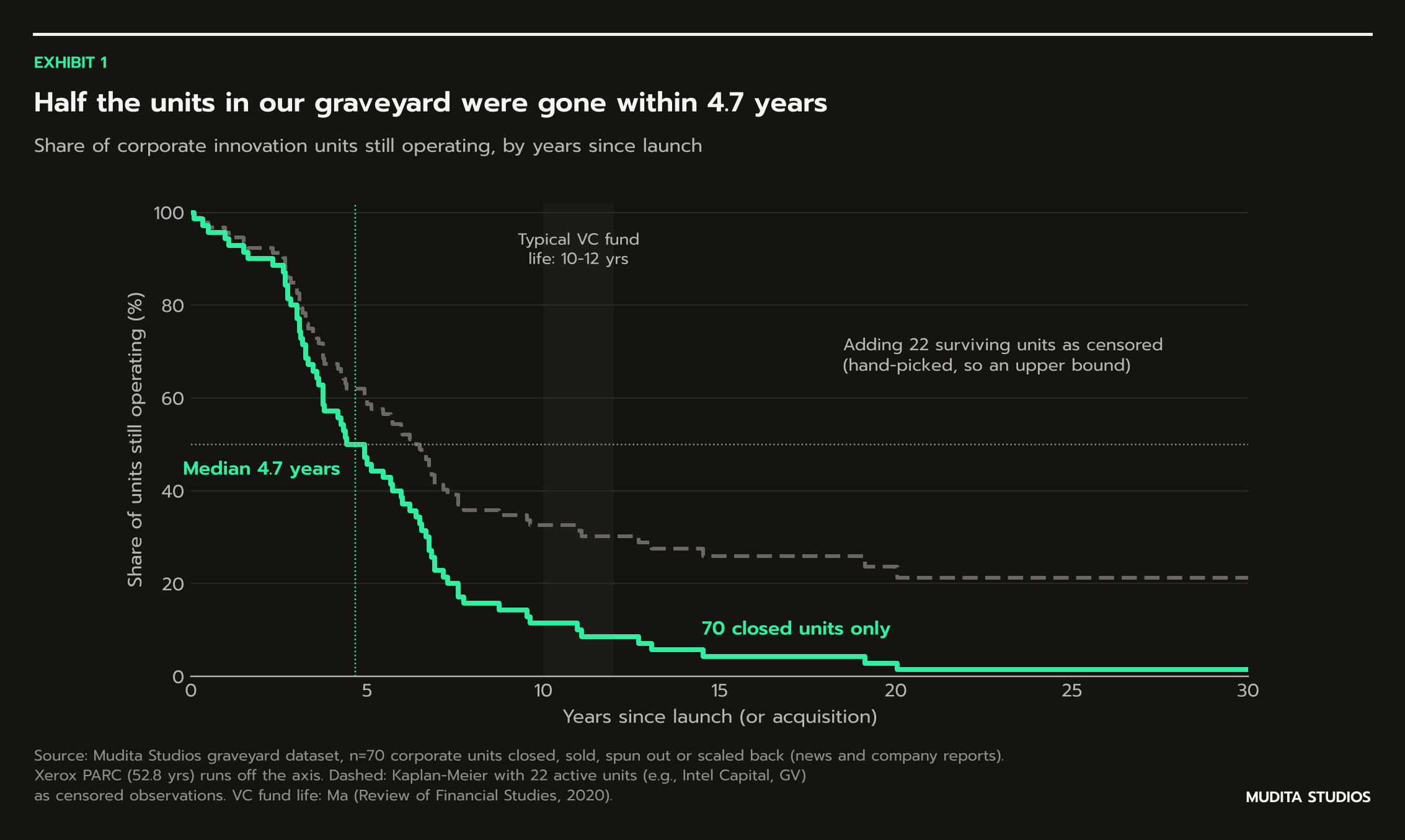
Exhibit 1 shows the survival curve. Of the units that eventually closed, the median one lasted 4.7 years (bootstrap 95% CI 3.8 to 6.0 years). The middle half lasted between 3.1 and 6.9 years. Only 8 of 70 lasted more than a decade, and a quarter were gone within about three years. Seven lasted less than two: CNN+ was shut one month after launch, Microsoft's Industrial Metaverse Core team lasted four months and NatWest's digital bank Bó six.
That matches the best academic benchmark we know. Song Ma's study of corporate venture capital (Review of Financial Studies, 2020) finds a median CVC life of about 4 years, against a fixed 10–12 year life for an independent VC fund. Our sample is broader and assembled differently, and it lands in the same place. The dashed line in Exhibit 1 adds the 22 survivors as still-open cases. Even that more generous curve has a median of 6.5 years, and our survivor list is hand-picked, so treat it as an upper bound.
The core mismatch follows from those numbers. The median unit in our data lived less than half the life of the VC funds it competes with for deals and founders, so most of these units could not have seen their own bets mature.
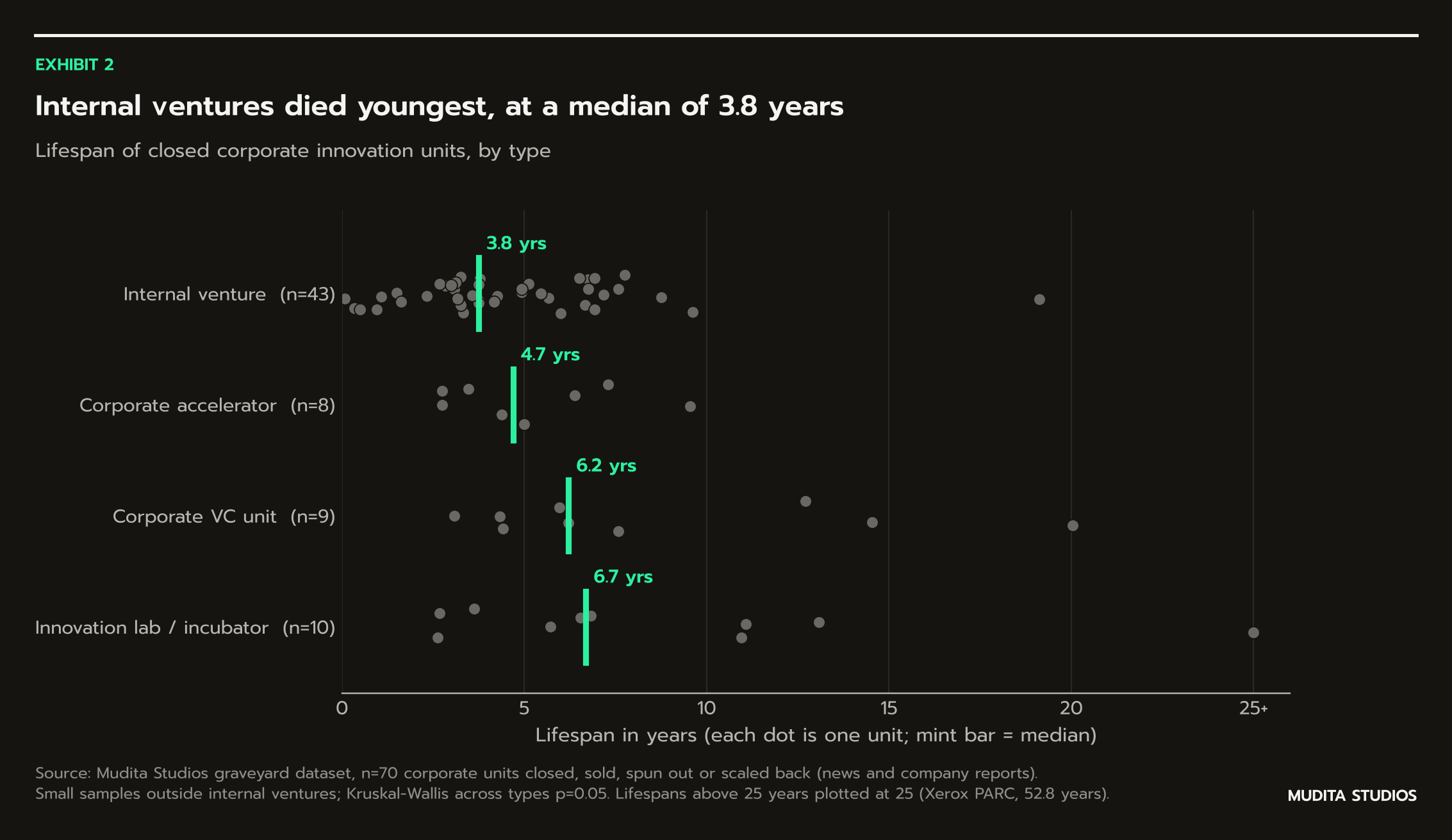
Exhibit 2 splits lifespan by type. Internal ventures died youngest, at a median of 3.8 years. Accelerators followed at 4.7, CVC units at 6.2 and labs at 6.7 (Kruskal-Wallis p=0.045; three of the four groups have ten or fewer cases). That ordering makes sense. An internal venture carries its own P&L, so its losses show up on the parent's income statement. A lab or a venture fund is cheaper to keep alive and easier to defend as an "option".
Table 1: Internal ventures had the shortest lives; labs and CVC units had the longest tails
| Unit type | Cases | Median (yrs) | 25th pct | 75th pct | Max |
|---|---|---|---|---|---|
| Internal venture | 43 | 3.8 | 3.0 | 6.6 | 19.1 |
| Corporate accelerator | 8 | 4.7 | 3.3 | 6.6 | 9.5 |
| Corporate VC unit | 9 | 6.2 | 4.4 | 12.7 | 20.0 |
| Innovation lab / incubator | 10 | 6.7 | 4.1 | 11.1 | 52.8 |
| All closed units | 70 | 4.7 | 3.1 | 6.9 | 52.8 |
Source: Mudita Studios graveyard dataset.
03
Finding 2: The parent usually decides, and usually when the parent changes
We coded each case's reported reason against seven structural failure modes: time-horizon mismatch, lack of autonomy, leadership change, budget cut, misaligned incentives, no path back to the core and fad abandonment. We also used three extra codes so that no case was forced into the taxonomy: market or regulatory failure, absorbed or strategic exit, and reason not disclosed. A case can carry more than one code (1.5 on average). The coding, with a note for every judgment call, is available on request.
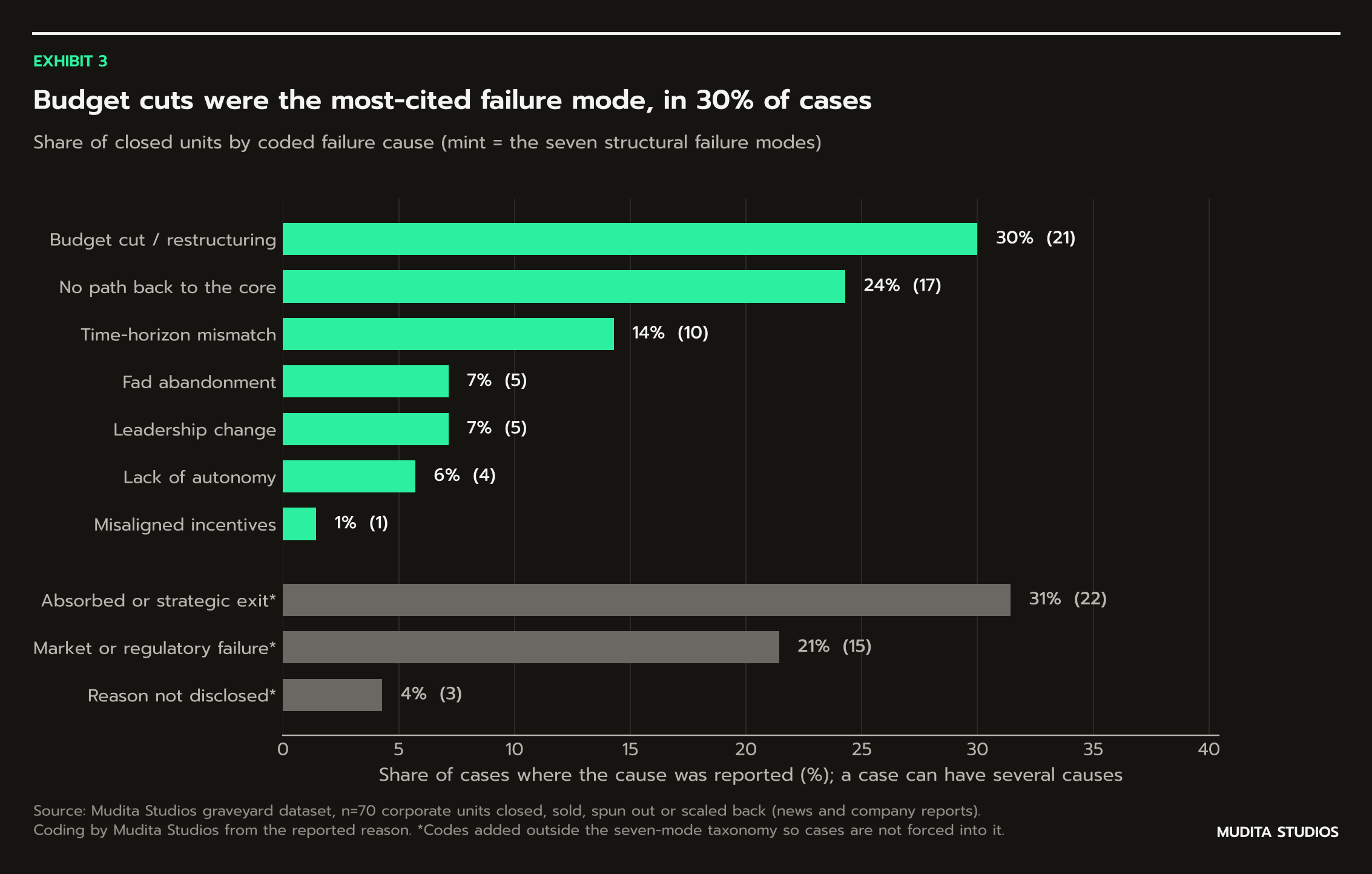
Exhibit 3 shows the result. Budget cuts and restructuring were the most-cited failure mode, in 30% of cases. Store No. 8, GE Ventures, Microsoft Research Silicon Valley, Disney's metaverse unit and General Mills' G-Works were all closed as part of company-wide cost programmes. Next came no path back to the core (24%): the venture was judged non-core or could not be plugged into the business. Examples include Coca-Cola Founders ("back to basics"), Wayra Ireland after Telefónica sold its Irish operator, and adidas moving Speedfactory technology to existing Asian suppliers. Time-horizon mismatch came third at 14%. Microsoft cut its industrial metaverse team because it wanted to "prioritize other projects generating short-term revenue". Alphabet closed Makani as it "espouse[d] financial discipline", and Ford and VW stopped funding Argo AI.
Two modes we expected to see more often barely appear in public reporting. Misaligned incentives turned up in one case: Haven, the Amazon–Berkshire–JPMorgan venture, where each founding company ran its own projects instead. Lack of autonomy turned up in four, three of them CVC units spun out to become independent. This is almost certainly a reporting artifact. Closure memos cite costs and strategy, not governance. The academic work points the other way: CVC units staffed with VC-experienced hires survive longer (Dokko & Gaba), and CVC performance gaps track pay design (Dushnitsky & Shapira).
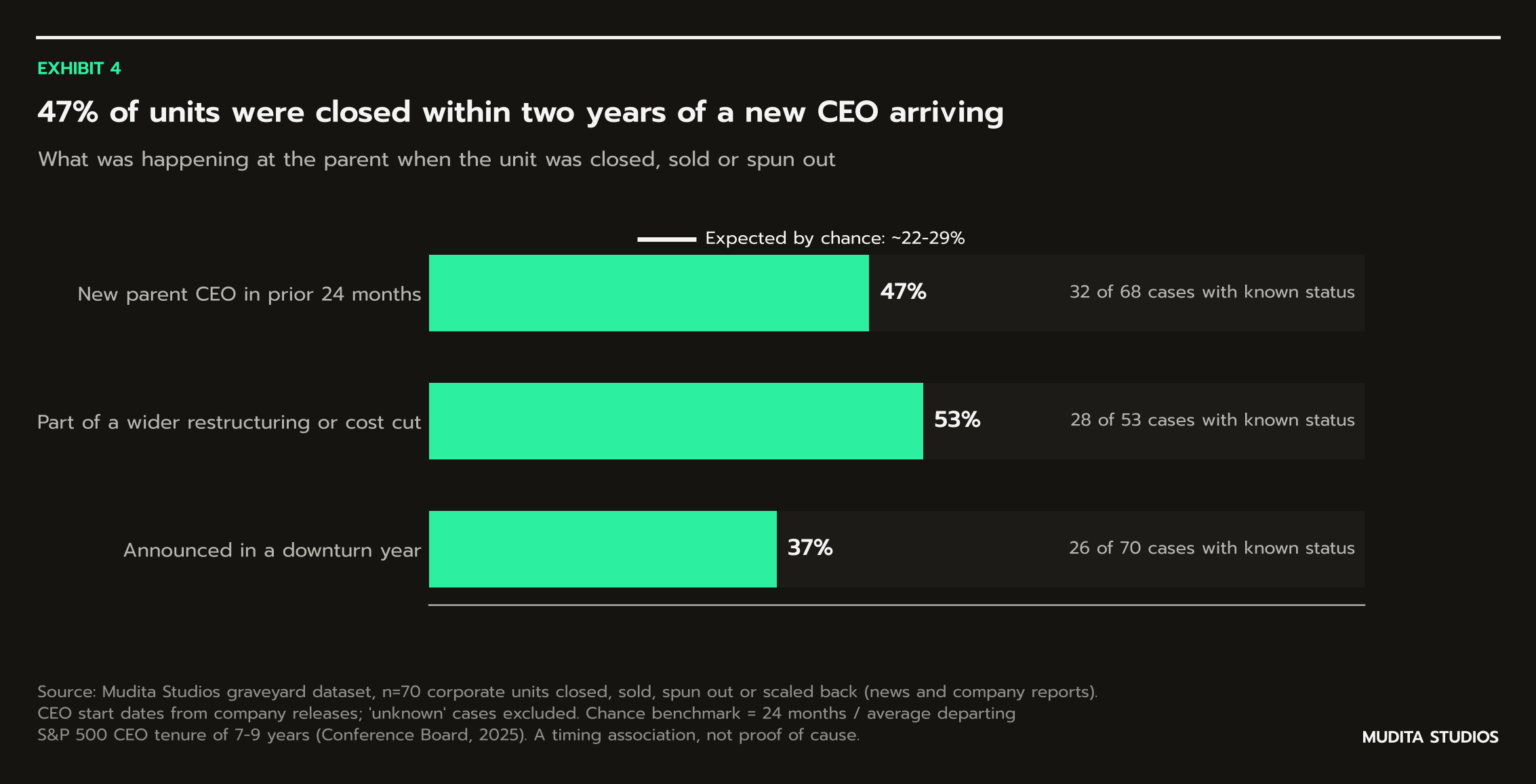
The timing data is harder to ignore than the stated reasons. 47% of units were closed within 24 months of a new CEO taking over the parent (Exhibit 4). Disney's metaverse division, created under Bob Chapek, was gone four months after Bob Iger returned. Nike wound down RTFKT two months into Elliott Hill's tenure. Starbucks ended Odyssey a year after Laxman Narasimhan arrived. BP announced the closure of BP Ventures three months after Meg O'Neill became CEO. With departing S&P 500 CEOs serving 7–9 years on average (Conference Board, 2025), random timing would put roughly 22–29% of closures inside such a window. Only five of the reported reasons name new leadership, yet the timing points to it far more often. New CEOs rarely say "I am killing my predecessor's bet." They say "focus".
04
Finding 3: Closures come in waves
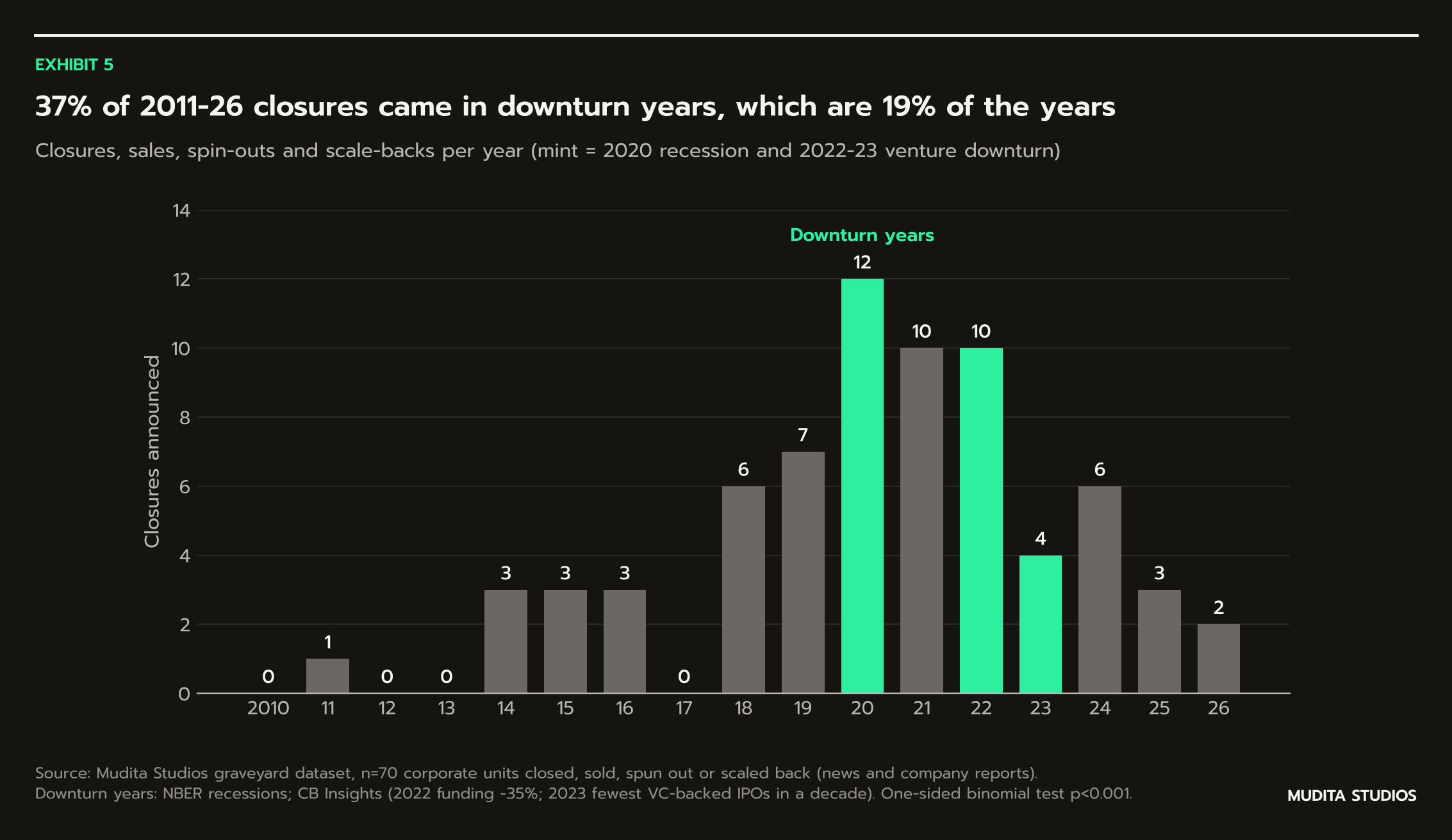
Exhibit 5 plots closures by year. Downturn years, meaning the 2020 recession and the 2022–23 venture downturn, account for 19% of the years in the 2011–2026 window but 37% of closures. They averaged 8.7 closures each, against 3.4 in other years. 2021 (10 closures, including Loon, Haven, Lyft Level 5 and Intel Sports) does not count as a downturn year under our definition. Counting it would make the clustering stronger, not weaker.
Two caveats matter. Our sample overweights recent, well-covered closures, which inflates the late-2010s and 2020s. And a downturn is both a cause and a cover story. It gives a new CEO or CFO a reason to cut what they already doubted. For a venture, though, the effect is the same either way: funding that depends on the parent's annual budget disappears exactly when competitors are cheapest to beat and talent is easiest to hire.
05
Finding 4: Some deaths are graduations
Nearly a third of our cases (31%) do not fit the failure story. Santander InnoVentures was spun out as Mouro Capital with its funds doubled to $400M, after self-reported IRRs of 25–35%. SAP Ventures became Sapphire Ventures. Uber sold ATG to Aurora and kept a stake. Airbus says Acubed "completed its mission" and handed its projects back. A fair reading of the graveyard is that corporates are poor at keeping ventures, not that every venture they start is worthless. A fifth of cases (21%) were plain market or regulatory failures: Stadia, Zillow Offers, Amazon Care, Meta's Novi. No structure fixes a product that customers do not want.
06
What studios do differently, and what they do not fix
A venture studio is not magic. It is a set of structural choices, and each one addresses specific failure modes in our data. Table 2 maps them.
Table 2: Each failure mode maps to a specific structural feature of a studio
| Failure mode | Share of cases | Example cases | Studio feature that addresses it |
|---|---|---|---|
| Budget cut / restructuring | 30% | Walmart Store No. 8; GE Ventures; Disney metaverse unit | External capital: the venture is funded by a committed fund and co-investors, not an opex line in the parent's annual budget |
| No path back to the core | 24% | Coca-Cola Founders; Nike RTFKT; Wayra Ireland | Kill gates with explicit strategic-fit tests, plus call options or buy-back rights agreed at the start |
| Time-horizon mismatch | 14% | GE Digital; Microsoft Industrial Metaverse; Argo AI | External capital with a 10-year fund life, released stage by stage through kill gates rather than annual budgets |
| Leadership change | 7% (47% by timing) | Disney metaverse unit; CNN+; Facebook Building 8 | Independent governance plus external capital: a separate board, contracts and co-investors outlast a new CEO |
| Fad abandonment | 7% | Nike RTFKT; Starbucks Odyssey; Viacom NEXT | Kill gates: money follows evidence at each stage, not the hype cycle |
| Lack of autonomy | 6% | BBVA Ventures; SAP Ventures; Haven | Independent governance: own entity, board, hiring and spending authority |
| Misaligned incentives | 1% | Haven | Venture-style equity: founders and operators own stakes that pay only on success |
| Market or regulatory failure* | 21% | Google Stadia; Zillow Offers; Meta Novi | Not solved by structure; kill gates aim to make the failure cheaper and earlier |
Source: Mudita Studios graveyard dataset, n=70; full taxonomy with definitions available on request. *Code added outside the seven-mode taxonomy.
The largest buckets, budget cuts and timing around CEO changes, are both about who controls the money and the calendar. A unit funded from the parent's operating budget is re-decided every year by people who did not start it. A studio venture funded by a committed vehicle with outside co-investors, a separate cap table and its own board needs an affirmative act to unwind: buying out co-investors, breaching agreements, writing down a stake that shows up in the accounts. That does not make it immortal. It means a cost-cutting memo cannot quietly close it.
Kill gates address the opposite problem. Many units in our data were not killed for failing tests. They were killed for being expensive at the wrong moment. A studio that kills most of its ideas early and cheaply, on evidence, uses failure as a budgeting tool rather than as a reputational event for the parent. The goal is to fail early, cheaply and on purpose, before a downturn or a new CEO decides for you.
Venture-style equity and independent governance address the modes that public reporting under-records. Our one clear incentive case, Haven, failed partly because its three parents kept doing the work themselves.
The honest part: studios have a graveyard too
Studios are not immune to any of this. The most rigorous count we know, Inniches' 2024 study built from PitchBook deal data and manual verification, found 1,107 studios established worldwide, 154 of which (14%) had ceased operating by September 2024. In Q3 2024 more studios closed (20) than opened (17). Pure studios survived worse than hybrids or corporate builders (4.7 active per closed, against 10.9 and 9.3). On outcomes, the same study found studio-backed deals exited 24% of the time against 38% for pre-seed VC-backed deals. Studios were faster to exit (4.5 vs 5.3 years) but not more likely to. Widely quoted claims of "53% IRR" for studios come from a 2020 self-reported trade-body survey (GSSN) and should be treated as marketing.
The 14% studio figure and our corporate graveyard are not comparable rates. We have no denominator of all corporate units ever launched. The point is that a studio relocates the risks in Exhibit 3 rather than removing them. The parent's budget cycle becomes the studio's fundraising cycle, and the parent CEO's patience becomes the LPs'. A corporate that partners with a studio should check the studio's own durability: fund life, LP base and track record of killing ventures early, alongside its pitch.
07
What to do with this
- Budget for ten years or don't start. If a venture's funding can be cut in an annual budget round, its expected life is about four to five years.
- Make it expensive to kill quietly. Separate entity, separate board and outside co-investors are what survive a CEO transition.
- Write the path back on day one. A quarter of our cases died as "non-core". Pre-agreed call options, buy-back rights and integration milestones turn a strategic-fit argument into a contract.
- Kill on evidence, not on the calendar. Stage gates with explicit kill criteria remove the need for a downturn to do the killing.
Implications
What this means for corporate innovation leaders
- Budget for ten years or don't start. Ventures funded through annual budget rounds tend to last four to five years.
- Make ventures expensive to kill quietly, with a separate entity, a separate board and outside co-investors.
- Write the path back to the core on day one, with call options, buy-back rights and integration milestones.
- Kill on evidence at stage gates with explicit criteria, before a downturn or a new CEO decides for you.
Appendix
Method, data and sources
Methodology & limitations
Dataset. We searched news, company releases and reference sources (Oct 2026) for named corporate innovation labs, accelerators, CVC units and internal ventures that were closed, sold, spun out or materially scaled back. We kept a case only if we could source both a launch date and a closure date. That gave 70 cases at 53 parents, launched 1970–2022 and closed 2011–2026. "Internal venture" includes 9 acquired startups run as units (e.g., Jet.com, Cruise, RTFKT) and 3 joint ventures (Haven, Argo AI, Axel Springer Plug and Play). Survivors (22) are a hand-picked comparison set, not a random sample.
Lifespan. Close date is the announcement of the closure, sale, spin-out or scale-back, not the last day of operation. Where a source gave only a year, we used mid-year. Lifespan is measured in years from launch (or acquisition) to announcement. Survivors enter the dashed curve in Exhibit 1 as right-censored at October 2026.
Causes. A single coder (Mudita Studios) coded each case from the reported reason. Codes are multi-label. Leadership change is coded as a cause only when reporting links the two. The separate CEO-timing flag is mechanical: a new parent CEO took office (or was named) within 24 months before the closure announcement. CEO start dates for "yes" cases are sourced; "no" codes were checked against known CEO tenures but are not individually sourced; 2 cases are "unknown". The chance benchmark (24 months ÷ 7–9 year average tenure) is a rough steady-state approximation for S&P 500 firms. Many parents here are European or not in the S&P 500.
Downturn years. 2001, 2008, 2009 and 2020 (NBER US recessions), plus 2022 and 2023 (global venture funding fell 35% in 2022; 2023 had the fewest VC-backed IPOs in a decade, per CB Insights). The test compares the share of closures in downturn years with the share of years that were downturns. It does not control for the recency of our sample.
Main limitations. (1) Selection bias: well-known, US-heavy, recent closures are overrepresented; quiet closures of small units are missing. (2) No denominator: we cannot compute a closure rate for corporate units, only the lifespan of those that closed. (3) Reported reasons are spin: companies cite "focus" and "cost", so governance and incentive failures are likely under-coded. (4) Some examples we set out to include could not be verified as closures. Disney's accelerator, Lowe's Innovation Labs, Mastercard's Start Path and Target's Takeoff are still running, and we list them as survivors. For Disney, Lowe's and Bayer we used other verified closures (the metaverse unit, Iris and the Mission Bay hub).
Reproducibility. The dataset and analysis code are available on request.
Sources
The full list of 184 sources, with publisher, date and reliability rating, is available on request. Key sources:
- Song Ma, "The Life Cycle of Corporate Venture Capital," Review of Financial Studies (2020), summary at Harvard Law School Forum (peer-reviewed).
- Dokko & Gaba via INSEAD Knowledge, and Dushnitsky & Shapira via Knowledge at Wharton (peer-reviewed).
- Malyy & Pog, Big Venture Studio Research 2024, Inniches (PitchBook data plus verification; independent-data).
- NBER business cycle chronology; CB Insights, State of Venture 2022 and 2023.
- Conference Board, CEO Succession 2025 (CEO tenure benchmark).
- Closure cases: e.g., Digital Commerce 360 on Store No. 8, Fortune on Disney's metaverse unit, CNBC on Haven, TechCrunch on BP Ventures, and 66 more in the full dataset (available on request).
- GSSN "53% IRR" figure: self-reported 2020 trade-body survey; cited here only as a claim, not as fact.