Mudita Studios ResearchThe Studio Series
The State of the Venture Studio, 2026
The studio boom is over. What comes next is a smaller, more hybrid industry with its capital held by a few firms, and studios now have to prove their case with audited numbers instead of marketing.
Executive summary
We rebuilt the venture studio landscape from an independent census of 1,107 studios, our own datasets of 126 studios and 91 capital raises, and an audit of 14 widely cited claims. It shows an industry that has stopped growing and must now prove its returns.
- 01
−0.3%
change in active studios from end-2023 to September 2024, on the independent count
Net formation has stalled
A studio operator's self-reported series rises 12.3% over the same year. Net additions fell every year after 2020, from +104 to −3, and 111 of 154 recorded closures came in 2022–24.
- 02
17.3%
of pure-play studios have closed, against 8.4% of hybrids
Pure-play studios are being shaken out
Pure studios make up 69% of new launches but 75% of closures. Causality is unproven, since a studio that later adds a fund is counted as a hybrid.
- 03
57%
Flagship Pioneering's share of US$12.2B in disclosed studio raises since 2020
Capital sits with a few firms
The top three firms hold 71% and the median raise is US$25M. Small raises are under-reported, so these totals are floors.
- 04
$0.26B
disclosed studio capital in 2025 outside the two life-science giants
Generalist studio funding pulled back
That is down from US$1.18B in 2021. The partial recovery to US$0.89B in 2026 rests mostly on a single US$542M fund for Alphabet X spinouts.
- 05
2 of 14
widely cited studio statistics that hold up in an independent check
Most headline claims fail
Hybrid survival and the studio-versus-accelerator exit comparison hold. The 53–60% IRR claims are two to three times what independent modeling supports.
01
The boom, the stall, and why it matters
Venture studios were the fashionable answer to the question "how do you build more companies with less risk?" for most of the last decade. Industry write-ups still describe the model as growing at about 10% a year. One report published this summer by a studio operator projects 1,500 studios by the end of the decade.
The independent data shows something different. In December 2024 the research group Inniches published a census of the studio landscape. It was built from PitchBook deal data and checked manually, studio by studio, and the authors released the anonymized studio-level file behind it. We downloaded that file and rebuilt the formation curve ourselves.
Exhibit 1 shows the result. Formation rose steadily through the 2010s and peaked in 2020, when 114 studios were founded and 10 closed. After that, launches fell and closures jumped. In all years before 2022 the dataset records 43 closures. In 2022–24 alone it records 111. In the first nine months of 2024, 20 studios closed and 17 opened.
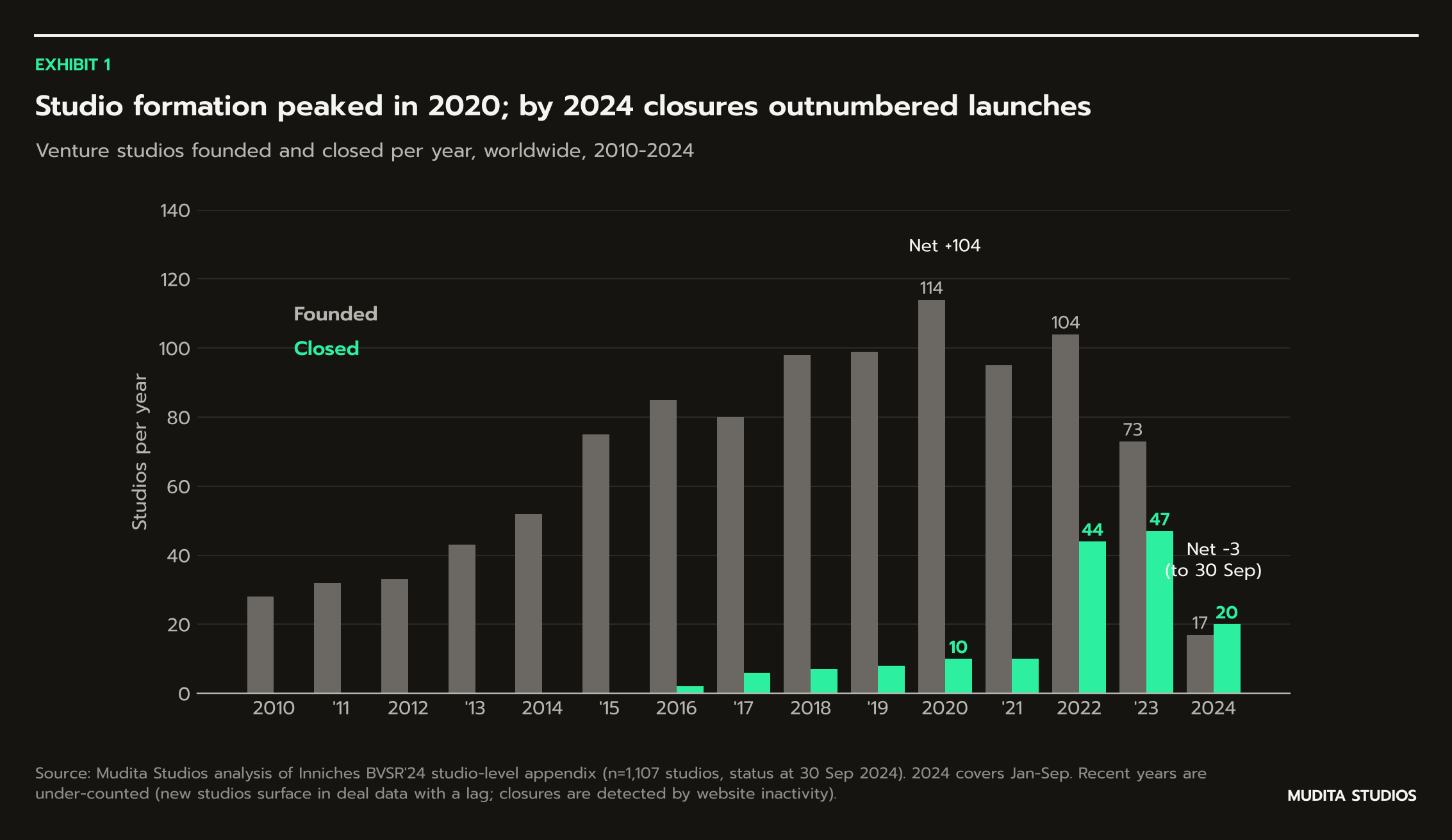
The most recent years carry a caveat that cuts both ways. New studios take time to show up in deal data, so 2023–24 launches are probably undercounted. Closures are also detected late, through website inactivity. We think the direction is robust because net additions fell in every year after 2020: +104, +85, +60, +26, then −3.
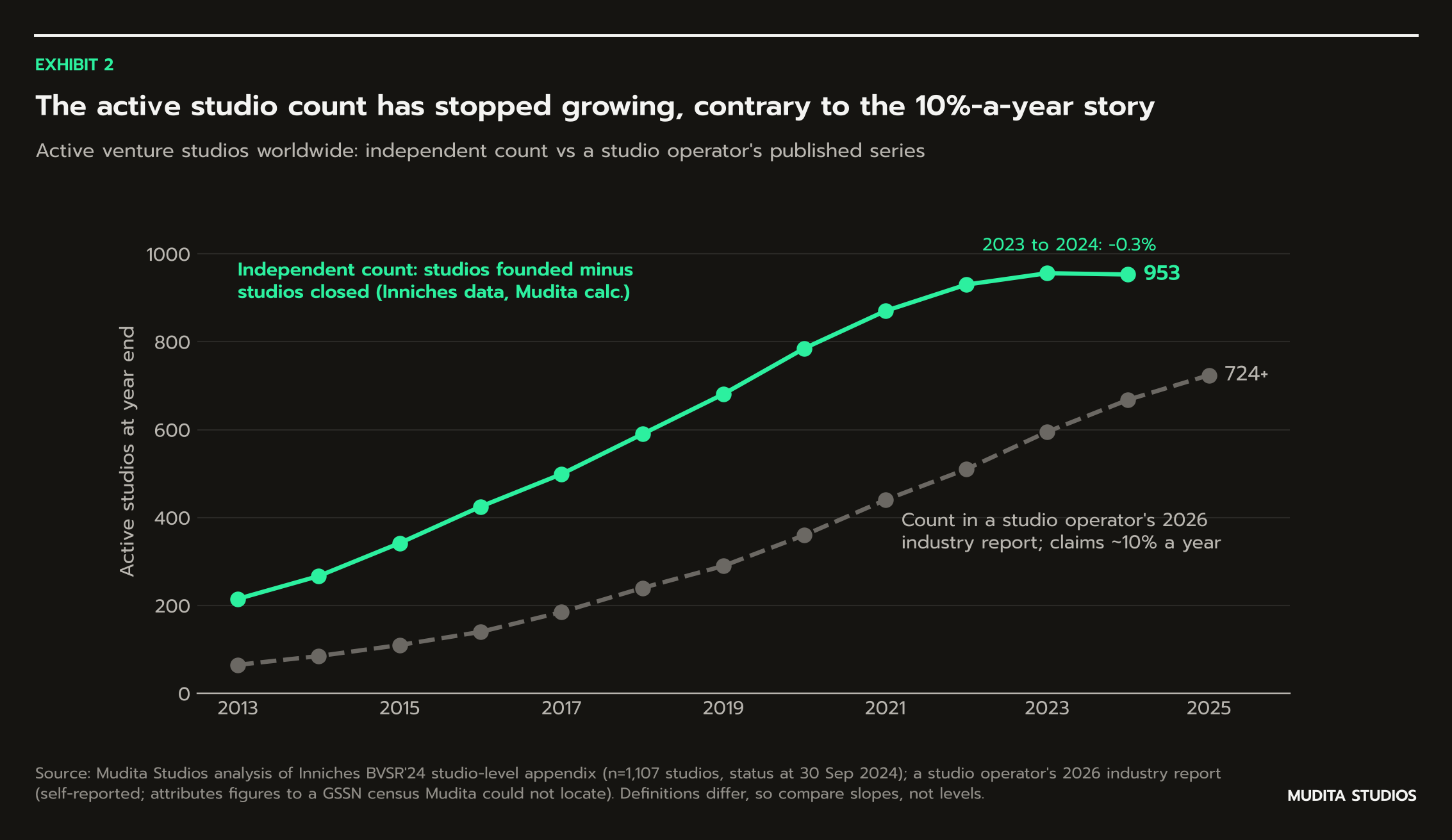
Exhibit 2 sets the stock of active studios against the series in a studio operator's 2026 industry report. Its figures are self-reported, and it attributes them to a GSSN census we could not locate. The two series use different definitions, so their levels are not comparable. Their slopes are. On the independent count, the active population went from 956 at the end of 2023 to 953 in September 2024, a change of −0.3%. The operator's series rises 12.3% over the same year.
A note on a widely repeated finding. Inniches reports a strong negative correlation (R = −0.87) between when a closed studio was founded and how long it lived, and reads this as "newer studios die faster." Some of that correlation is mechanical. A studio founded in 2021 that has already closed can only have lived three years. We would not lean on that statistic.
02
The shakeout is hitting pure-play studios
Which studios are closing? Exhibit 3 splits the 1,107 studios by model, using Inniches' taxonomy:
- Pure studios build their own ventures and do nothing else.
- Hybrids add a VC fund, corporate venture-building, consulting, an agency or an accelerator.
- Corporate builders primarily build ventures for corporations.
Pure studios have closed at 17.3%. Hybrids have closed at 8.4% and corporate builders at 9.6%. Put as survival ratios, that is 4.7 active pure studios per closure against 10.9 for hybrids.
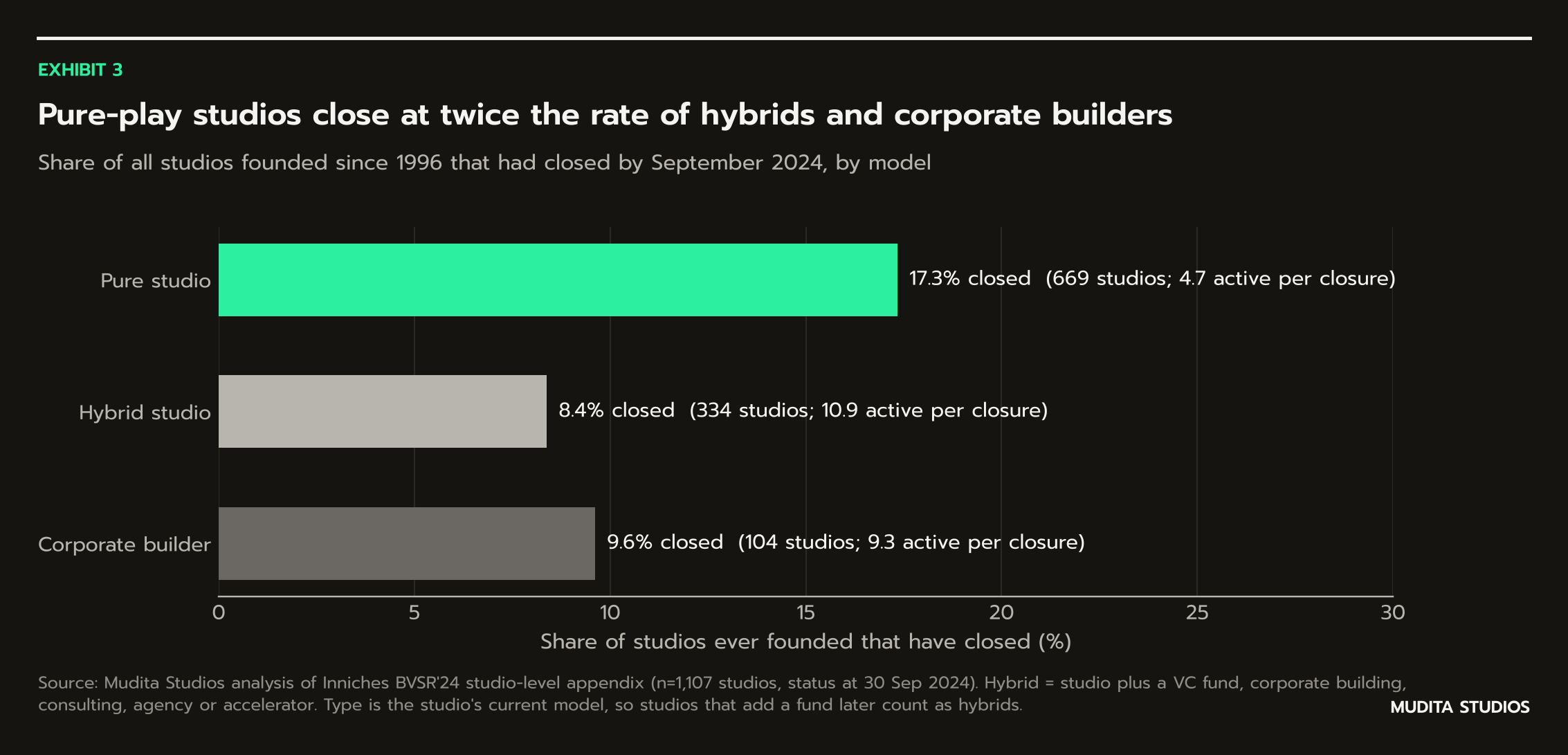
Exhibit 4 shows what this does to the population over time. Founders still launch pure studios: 69% of the 403 studios founded in 2020–24 were pure-play. But pure studios make up 75% of all closures and only 58% of the studios still active. The "rise of hybrids" is real, but it does not come from founders choosing hybrid models at launch. It comes from attrition among pure studios, and from survivors adding a fund, a corporate-services line or an accelerator to pay the bills.
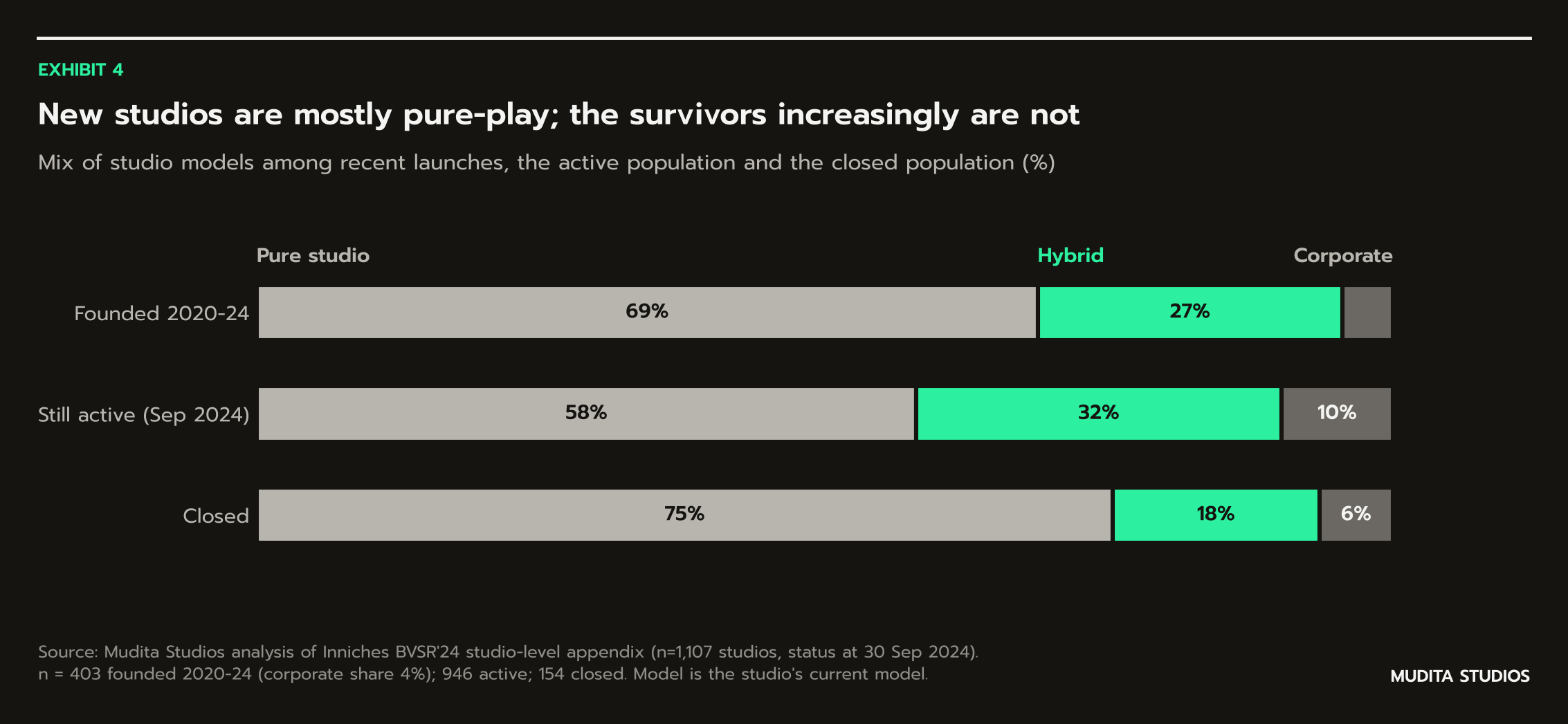
The causality is unproven. Inniches' type field records each studio's model today, so a studio that succeeded and later raised a fund is counted as a hybrid. Even so, the pattern fits what operators describe privately. Building companies without a revenue line is a long, expensive bet, and many studios have run out of runway before their portfolios produced liquidity.
What our own dataset adds
The Inniches file is anonymized. To see who is behind the numbers, we assembled our own dataset of 126 named, notable studios. It covers founding year, headquarters, model, sector, status and latest raise, and every row cites a source.
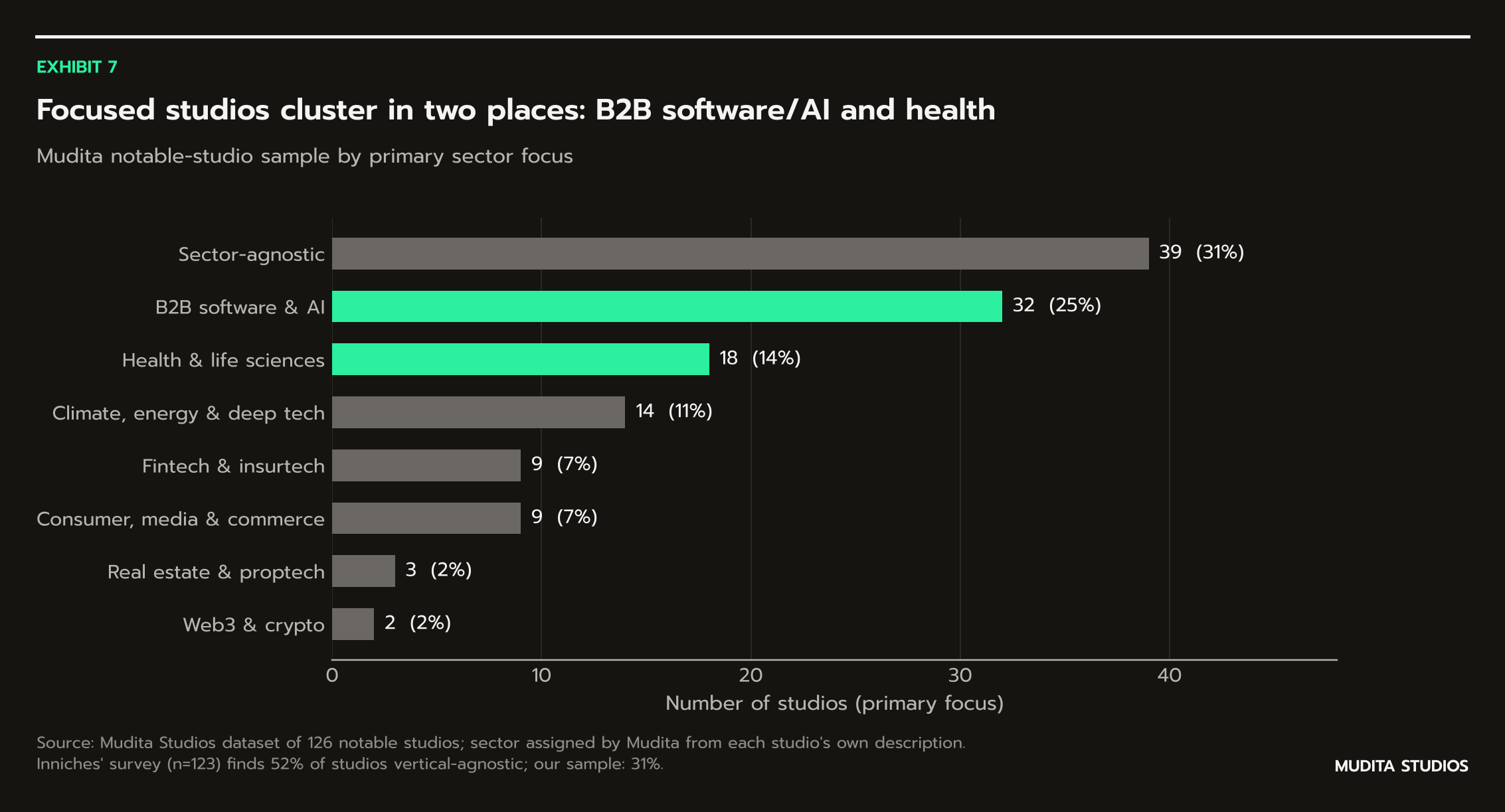
The dataset is deliberately skewed toward visible studios. 56% are North American, against 36% of all studios (Exhibit 5), and it understates failure among small studios. Within it, 23 studios have closed or left studio building (Table 3 in the appendix). Twenty of those 23 events happened since 2020.
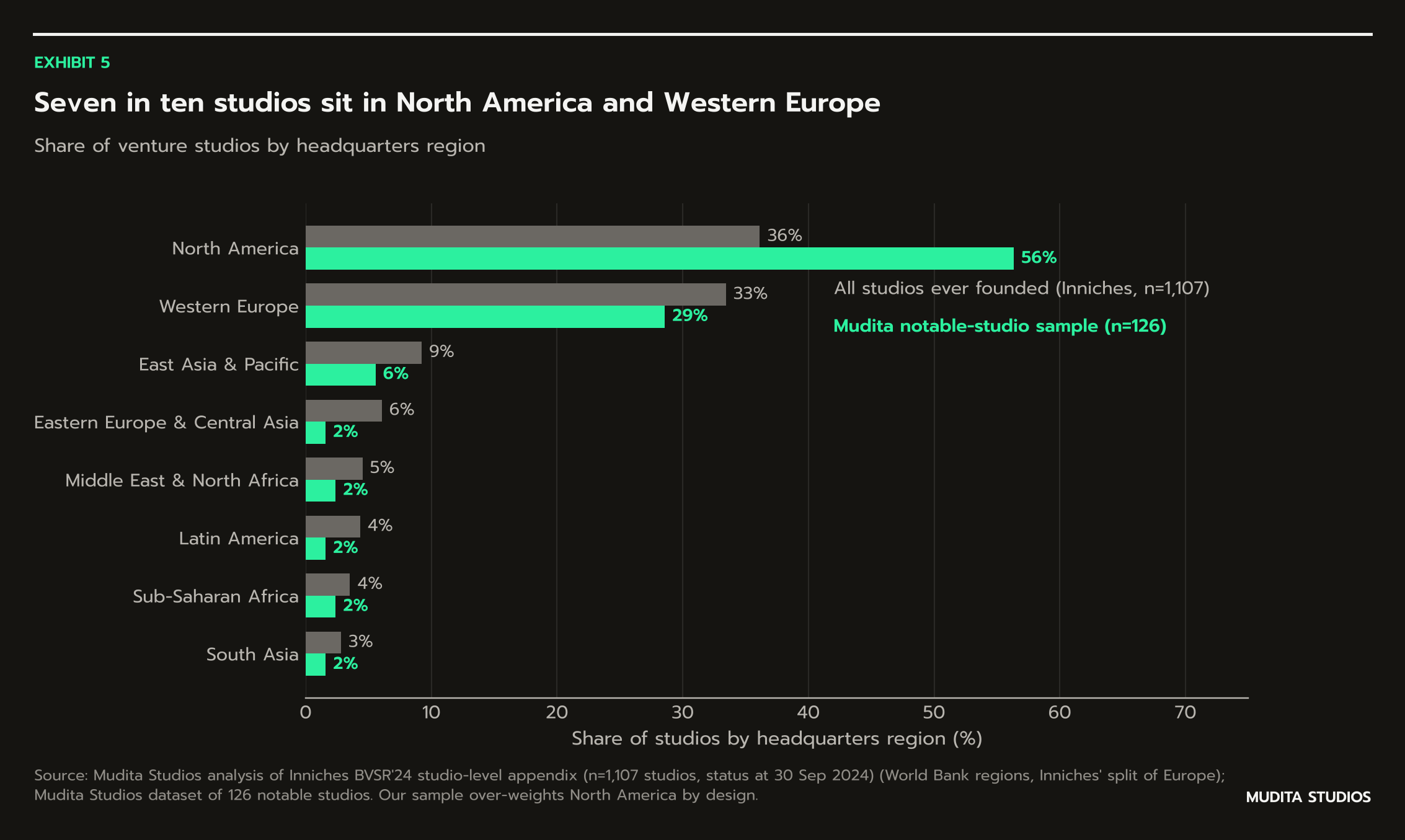
The named failures are concentrated among corporate builders (Exhibit 6). Twelve of the 32 corporate programs in our sample have closed or been folded into something else:
- Mach49: its listed parent, Next 15, announced a permanent wind-down in August 2025.
- Walmart's Store No. 8: closed in January 2024.
- Google's Area 120 and American Family's Tenney 110: both wound down in 2023.
- Pfizer Ignite: discontinued in 2025.
Inniches' aggregate data says corporate builders survive well as a category. Our sample says the most visible corporate programs are exactly the ones cut when a parent company's priorities change. Both can be true. Corporate venture building is durable as a service, and fragile as a line item in one company's budget.
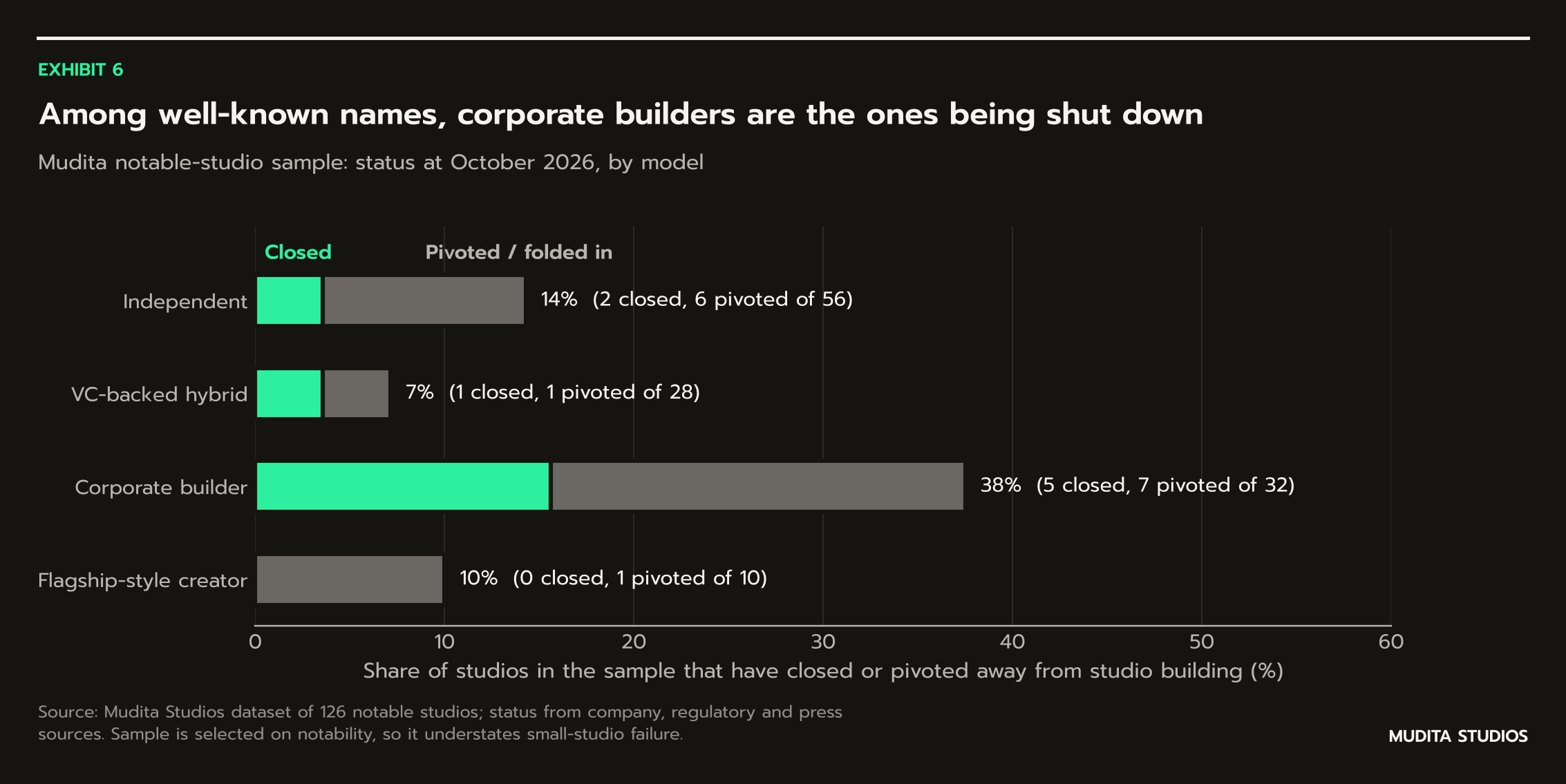
On sector (Exhibit 7), 31% of our sample is sector-agnostic. Inniches' survey puts the figure at 52%. The focused studios cluster in B2B software and AI (25%) and health and life sciences (14%). These are also the two places where the large recent raises went.
03
Capital: one industry on paper, two in practice
We built a second dataset of 91 studio-related capital raises from 2020 to October 2026, each linked to a press release, filing or news report. We then separated two kinds of vehicle:
- Capital that funds company creation: studio funds, life-science company-creation funds, studio holding-company equity and corporate-partner capital. This is 65 raises totalling US$12.2B.
- Affiliated VC funds: funds run by studio firms that mainly invest in outside companies. This is US$5.9B, excluded from the totals.
The result is extreme concentration (Exhibits 8–9). Flagship Pioneering raised US$6.93B across its 2020, 2021 and 2024 closes, 57% of everything we could find. Flagship, Third Rock Ventures and the new Series X Capital fund for X's spinouts together hold 71%. The top ten hold 89%. The bottom half of the 47 studios that raised hold 2.1% between them. The median raise was US$25M, and 60% of raises were under US$50M.
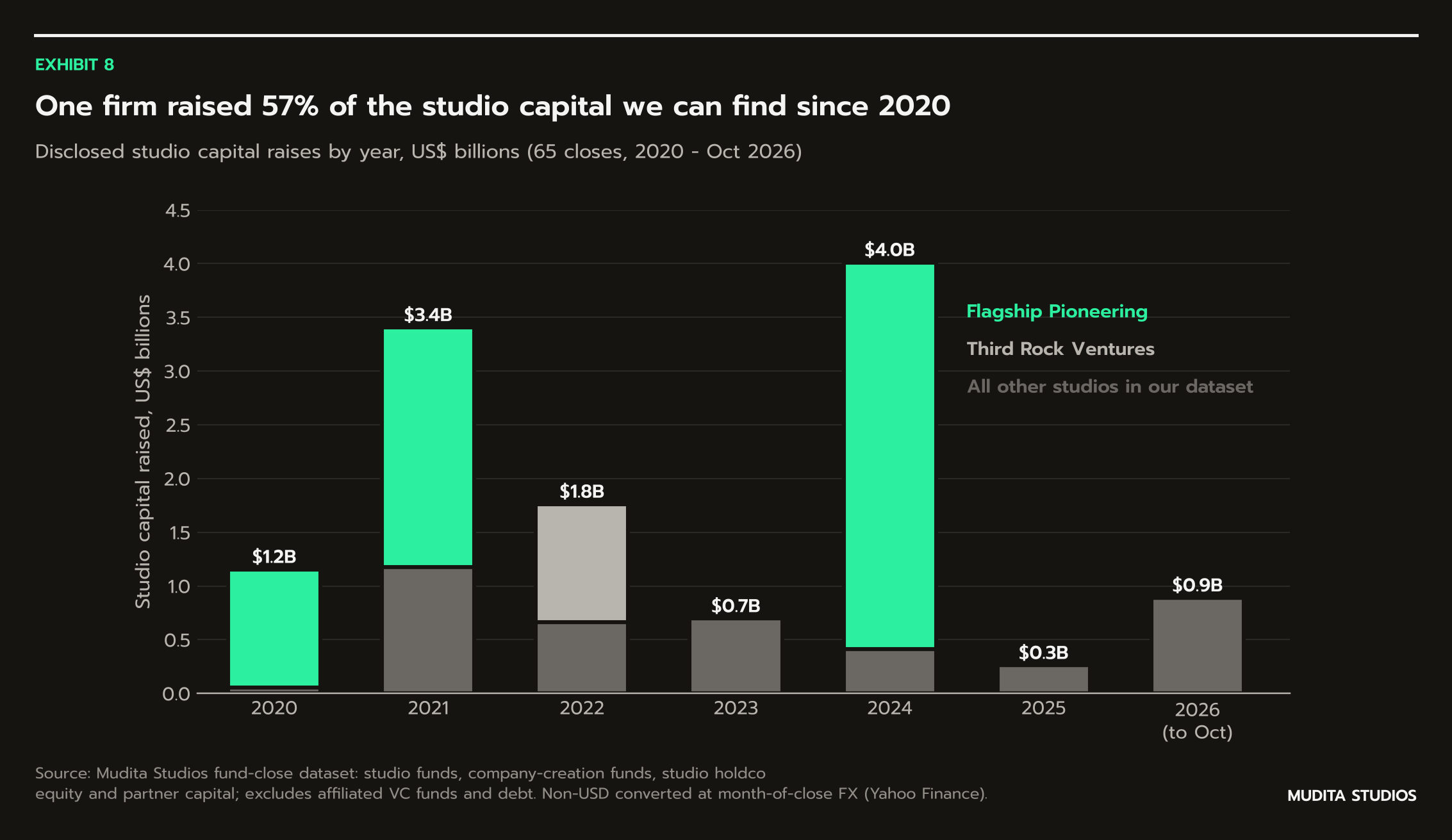
Strip out the two life-science giants and the trend is down. Disclosed studio capital from everyone else fell from US$1.18B in 2021 to US$0.41B in 2024 and US$0.26B in 2025. 2026 has partly recovered to US$0.89B, mostly because of a single US$542M fund for Alphabet X spinouts. Our counts of small raises are certainly incomplete, so read the levels as floors. The shape matches what the formation data shows: a funding market that pulled back from the generalist studio after 2021.
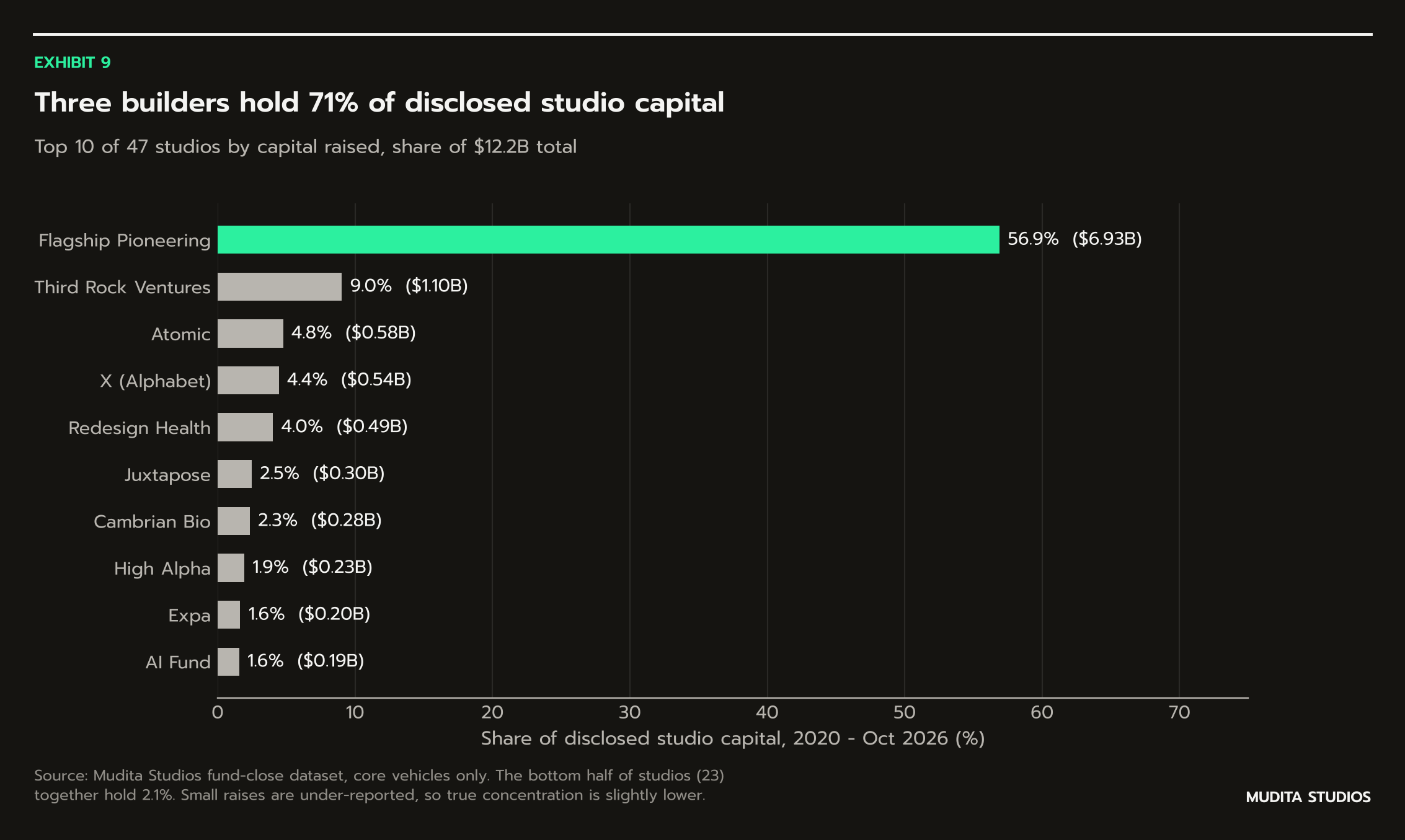
In practice, "the studio industry" is two industries. One is a few well-capitalized company creators, mostly in life sciences, that raise billions and build a couple of dozen companies per fund. The other is a long tail of studios raising US$5–50M funds, often with a thesis in AI-native B2B software. AI Fund, Forum Ventures, Pioneer Square Labs, Merantix and FutureSight all raised AI-themed studio vehicles in 2023–26. Commentary that treats these as one asset class with one return profile is misleading.
Table 2: The fifteen largest disclosed studio raises since 2020 are dominated by life-science creators
| Studio | Vehicle | Closed | US$m | Type |
|---|---|---|---|---|
| Flagship Pioneering | Fund VIII plus side funds | 2024-07 | 3,600 | company creation fund |
| Flagship Pioneering | Fund VII re-opening (additional capital) | 2021-06 | 2,230 | company creation fund |
| Flagship Pioneering | Origination Fund VII | 2020-03 | 1,100 | company creation fund |
| Third Rock Ventures | Fund VI | 2022-06 | 1,100 | company creation fund |
| X (Alphabet) | Series X Capital Fund I | 2026-03 | 542 | studio fund |
| Atomic | Atomic IV | 2023-05 | 320 | studio fund |
| Juxtapose | Juxtapose Ventures II | 2021-03 | 300 | studio fund |
| Atomic | Atomic III | 2021-03 | 260 | studio fund |
| Redesign Health | Holdco raise (operations + committed pools) | 2021-03 | 250 | holdco equity |
| Expa | Expa Capital III | 2022-04 | 200 | studio fund |
| AI Fund | Fund II | 2025-05 | 190 | studio fund |
| Redesign Health | Healthcare company-creation fund | 2024-12 | 175 | studio fund |
| Foresite Labs | Fund for Foresite Labs-incubated companies | 2022-03 | 173 | studio fund |
| High Alpha | High Alpha IV | 2024-06 | 125 | studio fund |
| Cambrian Bio | Equity offering (Form D) | 2026-06 | 124 | holdco equity |
Source: Mudita Studios fund-close dataset, compiled from press releases, regulatory filings and news reports. Non-USD converted at month-of-close FX.
04
What studios say about themselves, and what the data says
LPs have been told that studios deliver 53% IRRs, reach Series A twice as fast, and exit at more than twice the rate of normal startups. We traced the most-cited figures to their origins and tested each against independent evidence (Table 1).
Most come from two documents. One is GSSN's 2020 white paper, published by the studio trade body. Its studio funding figures come from an internal survey of 258 studio startups. Its 21.3% "traditional VC" IRR benchmark is cited from Industry Ventures, and the 53% studio IRR it compares against has no stated source. The other is a studio operator's 2026 industry report. It repeats the 53% figure but sets it against a 15% benchmark, which contradicts GSSN's own comparison. It is also internally inconsistent: it dates its "~65 studios" baseline to both 2013 and 2015.
Table 1: Most studio performance claims fail an independent check; the survival and accelerator comparisons hold
| Claim | Who says it | Source type | What independent data shows | Verdict |
|---|---|---|---|---|
| Studio IRR of 53% vs 21.3% for traditional VC | GSSN white paper, 2020 | self-reported | PitchBook-based model of pre-seed deals gives a 17% portfolio IRR; family-office LPs underwrite ~25%. GSSN gives no source for the 53%. | Not supported |
| Studio net IRR of ~60% | Vault Fund, 2023 (via Inniches) | self-reported | Unaudited survey figure. Inniches shows one unicorn in 100 deals moves modeled IRR from 17% to 25%: IRR averages are fragile. | Not supported |
| Studio IRR 53% vs 15% for seed (a 3.5x premium) | A studio operator's 2026 industry report | self-reported | Conflicts with GSSN's own 21.3% benchmark for the same comparison; underlying cohort study not locatable. | Not supported |
| Studio companies exit 27% vs 11% for traditional startups by year 10 | A studio operator's 2026 industry report | self-reported | In PitchBook pre-seed deals, studio-backed companies exited 24% of the time vs 38% for VC-backed (Inniches). | Contradicted |
| 84% of studio startups raise seed; 72% go seed to Series A (vs 42%) | GSSN, 2020 (survey of 258 studio startups) | self-reported | Studios' own reported funnel in the Inniches survey implies ~50% of seed-stage ventures reach Series A. | Contradicted |
| Studio startups reach Series A in 25 months vs 56 | GSSN, 2020 | self-reported | No independent replication found. | Unverified |
| 724+ active studios, growing ~10% a year | A studio operator's 2026 industry report (attributed to a GSSN census) | self-reported | Independent count: 953 active at Sep 2024 on a broader definition, but net change of -3 in 2024 (-0.3%) vs the claimed +12.3%. | Level plausible; growth contradicted |
| Corporate studios were ~35% of new studio formation in 2024 | A studio operator's 2026 industry report | self-reported | Corporate builders are 4% of studios founded 2020-24 and 9% of all studios (Inniches). Several big corporate builders closed 2023-25. | Contradicted |
| ~52% of studios are in North America, ~28% in Europe | A studio operator's 2026 industry report | self-reported | Inniches: 36% North America, 39% Europe (Western + Eastern). Europe, not the US, is the larger studio region by count. | Contradicted |
| US$14.2B of studio capital deployed in 2024 | A studio operator's 2026 industry report ('PitchBook est.') | self-reported | No PitchBook report found. Disclosed studio raises we can find total $4.0B for 2024, of which $3.6B is Flagship. | Unverified |
| Studio funds rose from 6% to 13% of new emerging VC funds (2024-25) | Monserrat blog, 2026 | anecdote | No data source named; not reproducible. | Unverified |
| 950+ studios tracked / 4,204 studio profiles | Enhance Ventures; Superscout | self-reported | Definition-dependent. A manually verified census found 1,107 studios ever founded, 946 active. | Overstated (definition) |
| Hybrid studios survive better than pure studios | Inniches BVSR'24 | independent-data | Recomputed: 17.3% of pure studios closed vs 8.4% of hybrids. Causality unclear (survivors may add a fund). | Supported |
| Studio-backed startups outperform accelerator-backed ones | Inniches BVSR'24 | independent-data | Pre-seed exit rate 24% (studio) vs 14% (accelerator) in PitchBook deals. | Supported |
Sources: claims as published by the organisations named; independent figures recomputed by Mudita Studios from the Inniches BVSR'24 appendix and the Mudita fund-close dataset.
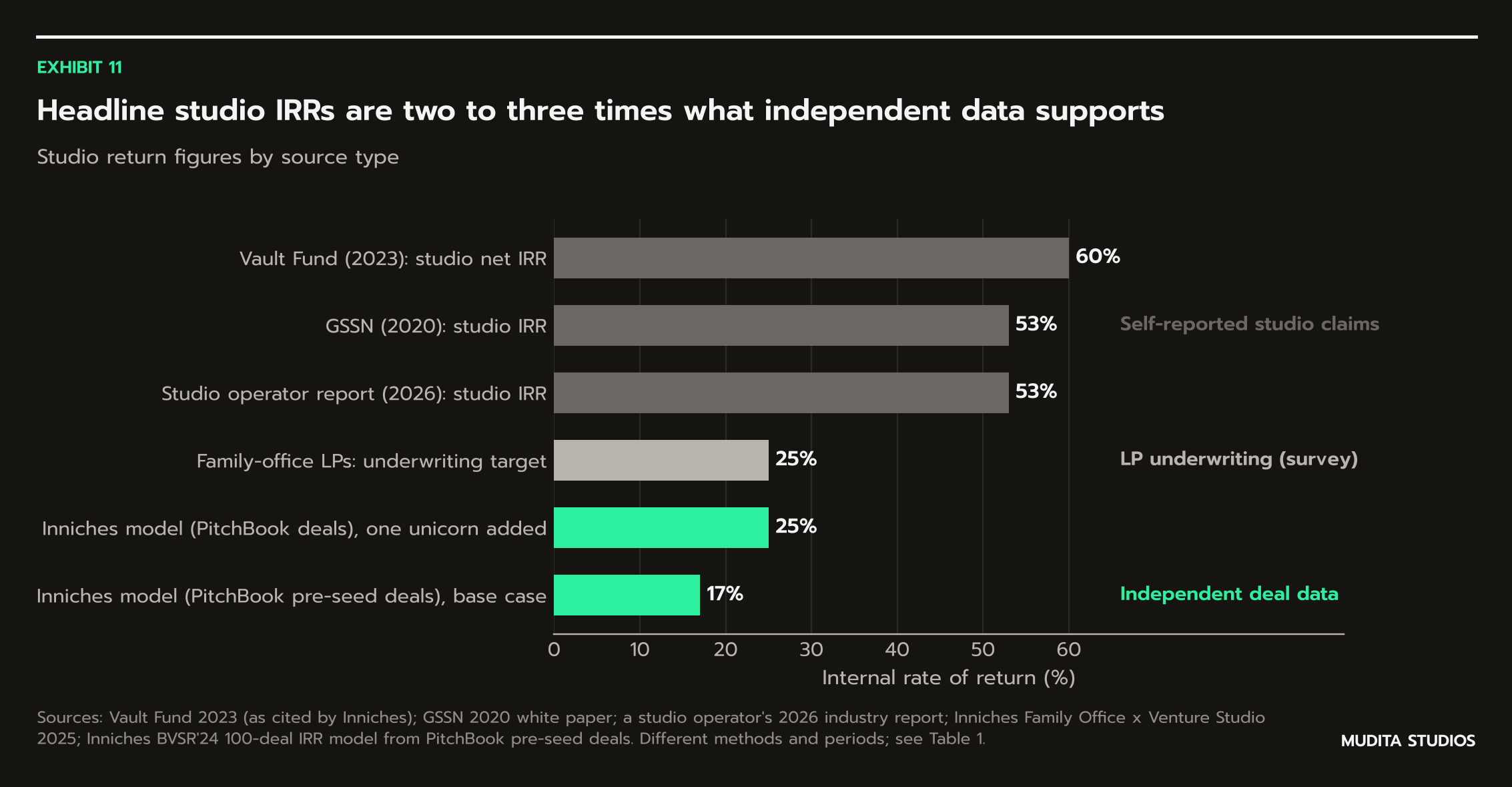
The return claims look the weakest (Exhibit 11). Inniches built a 100-deal portfolio model from real PitchBook pre-seed outcomes and got a 17% IRR. Changing one failed deal into a unicorn lifts that to 25%. A single outlier can therefore move an average IRR by half, which is why IRRs averaged across a few self-selected studios carry little weight. Family offices that actually write checks underwrite studios at about 25% IRR and 3–5x MOIC (Inniches, 2025). That is roughly what the independent data supports and far below the 53–60% in the pitch decks.
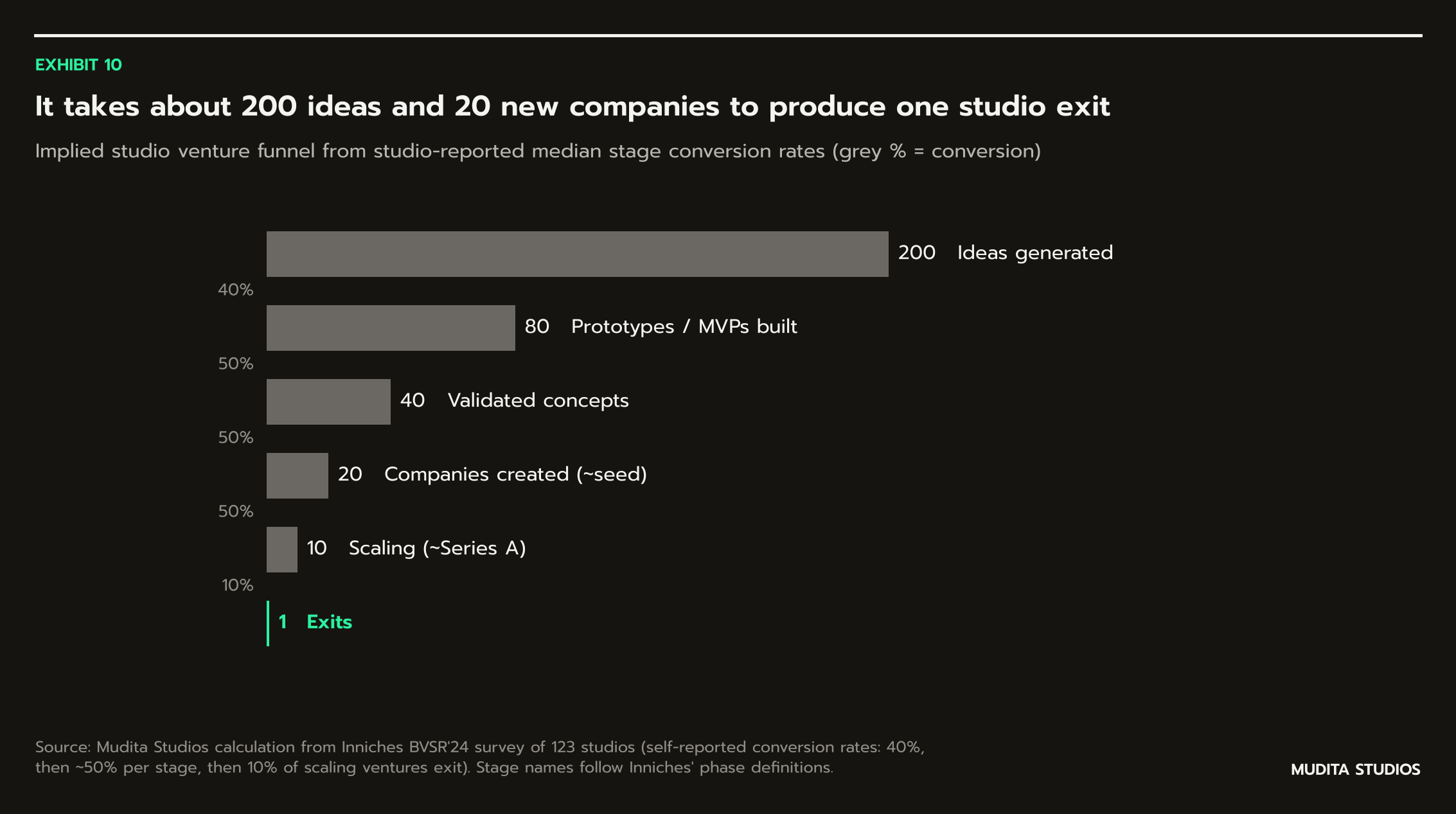
The studios' own funnel data points the same way (Exhibit 10). Studios surveyed by Inniches report converting 40% of ideas into prototypes, then about 50% at each later stage, then 10% of scaling ventures into exits. That works out to about 200 ideas, 20 new companies and 10 Series A-stage ventures for each exit. It is a respectable venture funnel. It is not the 84%-to-seed, 72%-to-Series-A machine described in the 2020 white paper.
None of this means studios do not work. On independent data, studio-backed pre-seed companies exit more often than accelerator-backed ones (24% against 14%), and the model's best operators have built enduring companies. It does mean the model's case should rest on evidence that can be checked.
05
What a mature studio industry looks like
We read the evidence as an industry moving from hype to maturity, in three ways.
- Fewer, more durable studios. The active count has flattened. Studios that survive tend to have a second revenue engine, such as a fund, corporate partners or services. A studio planning to live on carried interest from a five-year-old portfolio should plan for the median outcome, not the 2020 white paper.
- Capital follows proof. The firms that raised large funds since 2023 (Flagship, Atomic, AI Fund, Redesign Health, High Alpha, Merantix) all have long, visible track records or a sharp sector thesis. LPs are funding a few builders, not the category.
- The burden of proof has moved to the studios. The category's own marketing has become a liability. Sophisticated LPs now discount 53% IRR claims on sight. The studios that win the next fundraising cycle will publish audited, cohort-level outcomes: how many companies started, how many raised, at what cost and with what exits. Self-selected averages will not be enough.
This is also the yardstick Mudita Studios intends to be measured against.
Implications
What this means for LPs, founders and studio operators
- Plan for a second revenue engine. Studios with a fund, corporate partners or services close less often than pure studios.
- Discount 53% IRR claims. Underwrite studios at the roughly 25% IRR and 3–5x MOIC that family offices use.
- Ask studios for audited, cohort-level outcomes: companies started, how many raised, at what cost and with what exits.
- Treat life-science company creators and small software studios as separate asset classes with different return profiles.
Appendix
Method, data and sources
Methodology & limitations
- Independent census (Exhibits 1–5). We recomputed every figure from the anonymized studio-level appendix that Inniches published with its 2024 research (1,107 studios; status at 30 September 2024). Inniches defines closure as an announcement or prolonged website inactivity; seven "pivoted" studios are excluded from closure counts. Recent years are affected by detection lags in both directions. The model ("type") field records each studio's current model, not its model at founding. Regions follow Inniches' World Bank-based assignment.
- Mudita studio dataset (Exhibits 5–7, Table 3). 126 notable studios, drawn from widely cited names, a public studio directory (Startup Studio Insider) and studios surfaced while compiling fund closes. For each studio we recorded founding year, headquarters, status and recent raises from company websites, regulatory filings, data providers and news coverage, and we checked every closure, pivot and large fund close cited in this article against its original source. Model and sector are Mudita's classification from each studio's own description of itself. The sample is selected on notability, so it over-represents North America and well-funded studios and understates failure among small studios. Two public studio lists we hoped to use, the GSSN member directory and the Venture Studio Index database, are no longer online.
- Fund closes (Exhibits 8–9, Table 2). Disclosed raises only. Small raises are under-reported, so totals are floors. "Studio capital" means studio funds, company-creation funds, studio holding-company equity and corporate-partner capital; VC funds run by studio firms that mainly back outside companies (US$5.9B) and debt are excluded. Non-USD amounts are converted at month-of-close exchange rates. Flagship's 2021 figure counts only the new US$2.23B, not the full US$3.37B Fund VII pool. Treating Flagship and Third Rock as studios is a judgment call; the text also shows the trend without them.
- Claims (Table 1, Exhibits 10–11). Claimed figures are quoted from their source documents and labelled self-reported. The funnel is reconstructed from the median conversion rates studios reported to Inniches, which are themselves self-reported. The IRR figures in Exhibit 11 use different methods and periods and are not like-for-like.
- Data availability. The full studio and fund-close datasets, with a source for every row, are available on request.
Appendix
Table 3: 23 of the 126 notable studios have closed or left studio building. Named cases since 2023 include Mach49 (closed 2025), Pfizer Ignite (2025), 54 Collective/Founders Factory Africa (2025), Wagmi Venture Studio (2025), Walmart Store No. 8 (2024), Area 120 (2023), Tenney 110 (2023), Madrona Venture Labs (folded into Madrona, 2025), Fractal Software (stopped creating companies, 2023) and Syncona (shifted to realising its portfolio, 2026). The full list is available on request.
Table 4: Coverage of the Mudita studio dataset
| Field | Filled | Share |
|---|---|---|
| Studios (rows) | 126 | 100% |
| Founded year | 126 | 100% |
| HQ country | 126 | 100% |
| Status | 126 | 100% |
| Closure/pivot with a cited source (of 23) | 21 | 91% |
| Latest raise 2020-26 found | 57 | 45% |
| Founded year confirmed by a primary or press source | 68 | 54% |
Source: Mudita Studios dataset of 126 notable studios.
Sources
- Inniches, Big Venture Studio Research 2024 (Dec 2024): landscape census, anonymized studio-level appendix, survey of 123 studios and PitchBook pre-seed deal analysis. https://inniches.com/big-venture-studio-research. Independent data / industry survey.
- Inniches, Family Office x Venture Studio Research 2025. https://inniches.com/family-office-venture-studio-research-2025. Industry survey.
- GSSN (Global Startup Studio Network), Disrupting the Venture Landscape (Nov 2020). https://insightstudios.s3.amazonaws.com/Disrupting-the-Venture-Landscape_GSSN-White-Paper-1.pdf. Self-reported.
- A studio operator's 2026 industry report (Jun 2026). Self-reported.
- Vault Fund, 2023 Company Creator Insights (as cited by Inniches). Self-reported.
- Enhance Ventures, https://enhance.online/ecosystem-building; Superscout venture studio directory, https://superscout.co/venture-studios; Startup Studio Insider directory, https://www.startupstudios.com/startup-studio-directory. Self-reported directories.
- K. Monserrat, "A bigger fund won't fix your venture studio" (Aug 2026). Opinion.
- Business Horizons (2025), "Venture studios beyond the hype," https://www.sciencedirect.com/science/article/pii/S0007681325001417. Peer-reviewed.
- Next 15 Group plc, regulatory announcement on Mach49 (28 Aug 2025), https://www.businesswire.com/news/home/20250827192079/en/Next-15-Group-plc-UK-Regulatory-Announcement-Statement-re-Intention-to-permanently-cease-operations-at-Mach49.
- Disrupt Africa, "54 Collective shuts down venture studio" (23 Jul 2025), https://disruptafrica.com/2025/07/23/54-collective-formerly-founders-factory-africa-shuts-down-venture-studio-amid-mastercard-foundation-dispute.
- Fund closes: company press releases, SEC Form D filings and news reports (Flagship Pioneering, Third Rock Ventures, Atomic, High Alpha, AI Fund, Redesign Health, Merantix, Forum Ventures and others). Exchange rates: Yahoo Finance monthly closes.