
Mudita Studios ResearchThe Studio Series
The Studio EffectDo Corporate Studio Partnerships Move Stock Prices?
Investors don't reward the press release. We tracked 44 announcements by listed companies working with venture studios and found no announcement premium and no long-run outperformance. What creates value is the work that comes after.
Executive summary
We tested whether listed companies that announce venture studio partnerships see their stock rise, using 44 announcements from 2012 to 2026. They do not, and the result shows where a studio partnership's value has to be measured instead.
- 01
+0.35%
average 3-day abnormal return on 37 first-time announcements
No announcement premium
The result is far from significant (p = 0.45; 95% CI −0.52% to +1.24%). Only 57% of events were positive, which is close to a coin flip.
- 02
−4.1 pp
average one-year return gap against the local index
No long-run premium either
69% of partners trailed their index after one year (95% CI −10.9 to +2.8 pp). At three years the mean gap was −1.5 pp, with half above the index and half below.
- 03
6.6%
median annual stock growth of studio partners, against 10.8% for their indices
CP's yardstick gives the opposite result
CP Ventures found CVC parents grew 10.4% a year against 6.2% for their index. With the same arithmetic, only 34% of studio partners beat their index. Neither result is causal.
- 04
1.3%
smallest 3-day reaction that 37 events can reliably detect
The study could only see large effects
Prior research points to effects well below that. Detecting a +0.5% reaction would take about 245 events, more announcements than we believe exist.
- 05
45%
Next 15 Group's three-day loss after a Mach49 client contract was not renewed
Markets react when the studio is material
Mach49 supplied a large share of a mid-cap's revenue. A partnership announcement by a large-cap insurer, by contrast, is a rounding error to investors.
Josh Linkner, a partner at Mudita, asked us a simple question: do companies that partner with a venture studio see better results and better stock performance? The question is reasonable. CP Ventures (formerly Touchdown Ventures) has published an analysis for several years running showing that corporations with venture capital arms beat their stock-market index. Their 2024 edition reports that the median of the 50 most active US corporate venture capital (CVC) parents grew its share price at 10.4% a year from CVC launch to December 2023. Their listing indices grew at 6.2% a year, which CP calls a 68% outperformance [S001]. If CVC parents outperform, studio partners might as well.
We built the dataset to test that idea, and we report what it shows even though the answer isn't the one a venture studio would prefer.
01
What we built
No public database of corporate–studio partnerships exists, so we assembled one by hand from press releases, company announcements and trade press. We collected every publicly announced partnership we could date between a listed corporation and an external venture studio or venture builder from 2012 to 2026. For each one we recorded the press-release date and source.
The final list has 44 announcements by 40 listed companies with 11 studios (Exhibit 1):
- 39 first-time partnerships, which form the main sample;
- two renewals (Aviva and Founders Factory in 2021 and 2026);
- three events involving Next 15 Group and Mach49, which we analyse separately.
Founders Factory accounts for 18 of the 44. Its partners include Aviva, L'Oréal, easyJet, M&S, Reckitt, Deutsche Telekom, Mediobanca and Rio Tinto. The rest come from:
- Flagship Pioneering's company-creation alliances with Novo Nordisk, Pfizer, Thermo Fisher, Samsung C&T, Analog Devices, GSK and IQVIA;
- Rocket Internet's joint ventures and equity tie-ups with telecom and internet groups and an insurer between 2013 and 2016;
- Alloy Partners' studios with Huntington and Elanco;
- smaller sets from Rainmaking, WiL, M13, Prehype, FinLeap and Creative Dock.
Many relationships named on studio websites (BCG X, McKinsey Leap, Mach49's clients, Alloy's work with Capital One and Lilly) have no dated public announcement, so they can't be event-studied. A list of them is available on request.
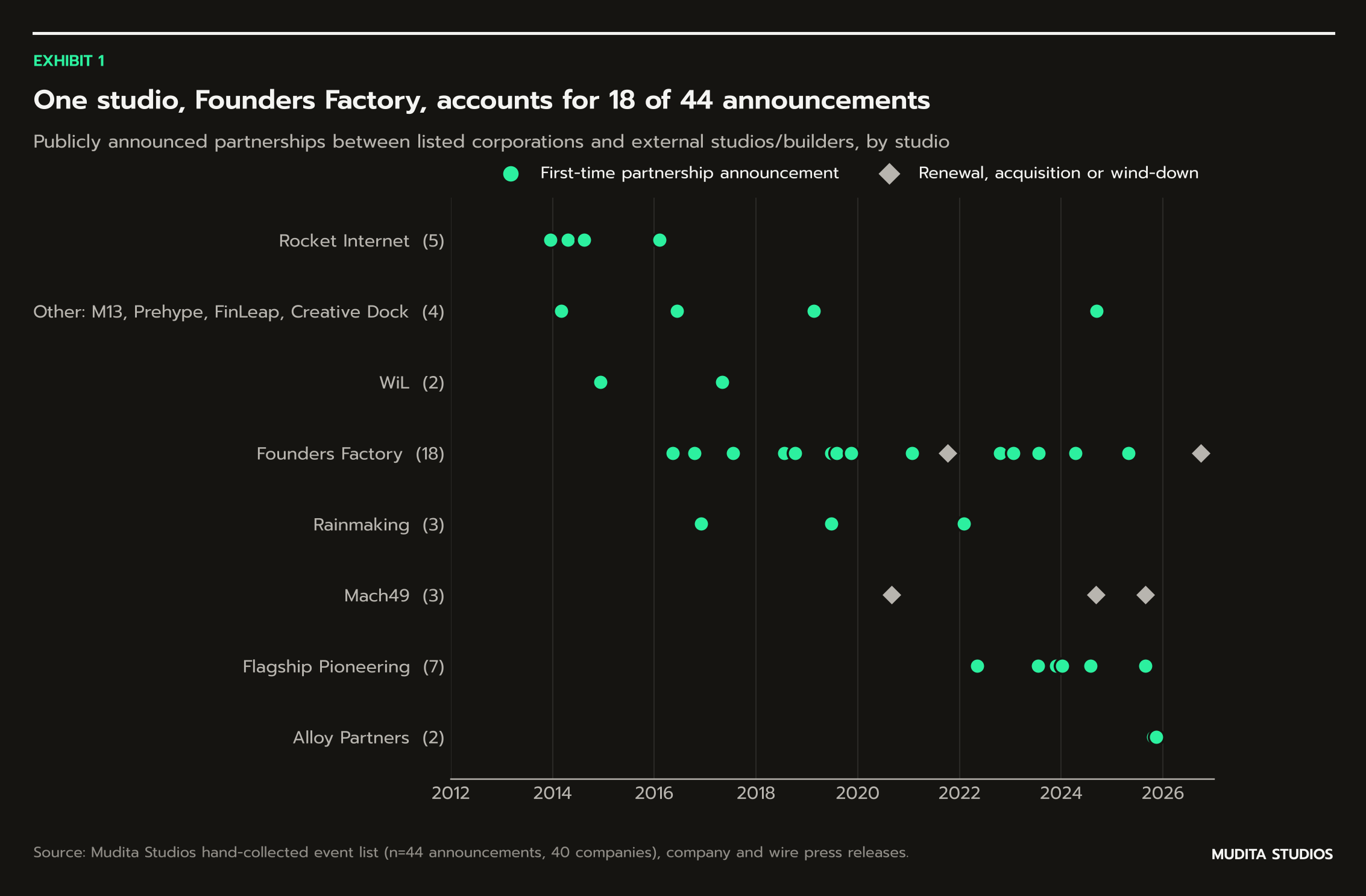
Exhibit 1. One studio, Founders Factory, accounts for 18 of 44 announcements.
The partnerships fall into four types:
- 16 co-creation joint ventures or dedicated studios;
- 12 equity stakes in a studio or a studio's holding company;
- 7 venture-creation alliances in biotech and life sciences;
- 4 studio-run accelerator programmes.
The main sample covers 39 companies, each with one first-time partnership. Interpublic was delisted after its merger with Omnicom and has no price history, and Rezolve AI's pre-2024 prices belong to a SPAC shell. That leaves 37 events for the short-window study and 36 that are at least a year old.
We ran the analysis two ways.
02
Analysis A: the CP Ventures yardstick
First we repeated CP's method exactly. For each partner we took the price-only CAGR of its stock from the announcement-day close to the latest close (13–14 October 2026) and compared it with the CAGR of its listing index over the same period. Like CP, we compare the median company's growth rate with the median index growth rate.
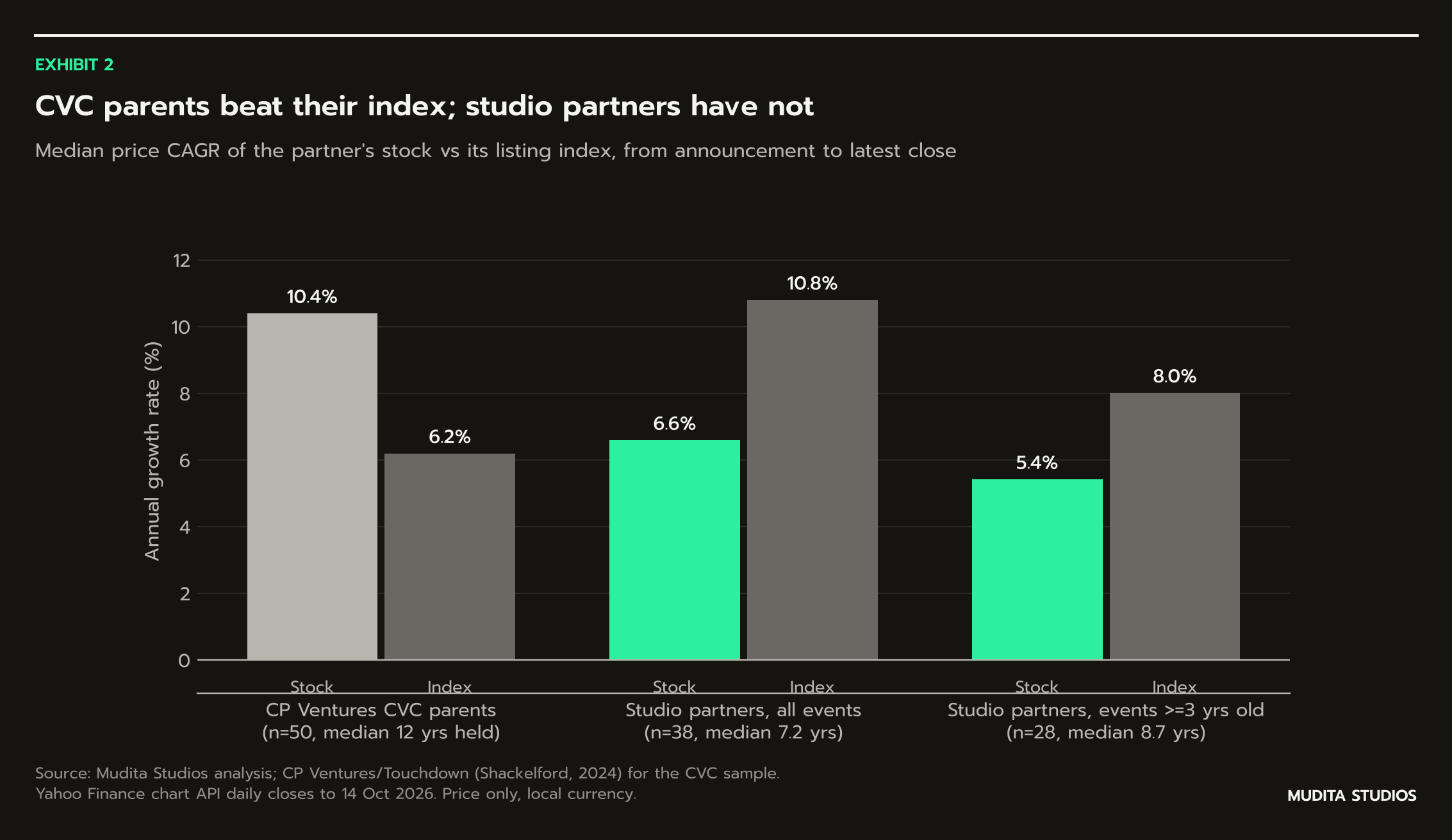
Exhibit 2. CVC parents beat their index; studio partners have not.
Table 1: Measured CP's way, studio partners trail their index by about a third
| Sample | N | Median years | Median stock CAGR | Median index CAGR | Relative "premium" (CP method) | Share beating index |
|---|---|---|---|---|---|---|
| CP Ventures: 50 most-active US CVC parents | 50 | 12.0 | +10.4% | +6.2% | +68% | not reported |
| Studio partners, all first-time events | 38 | 7.2 | +6.6% | +10.8% | −39% | 34% |
| Studio partners, events at least 3 years old | 28 | 8.7 | +5.4% | +8.0% | −32% | 36% |
Source: Mudita Studios analysis; Yahoo Finance daily closes to 14 Oct 2026 [S004]; CP Ventures/Touchdown 2024 [S001].
By CP's yardstick, studio partners underperformed. The median per-company gap is −4.6 percentage points a year. The bootstrap 95% CI on that median runs from −7.7 to +0.2, and the Wilcoxon p is 0.05.
We don't conclude that studio partnerships destroy value. The result shows how fragile this kind of comparison is:
- It depends on the period. Over our windows the median benchmark index compounded at 10.8% a year, against 6.2% in CP's sample.
- It depends on who is in the sample. Our partners are older-economy incumbents (insurers, telcos, consumer staples, big pharma) in the middle of turnarounds.
CP found +68% and we found −39% with the same arithmetic. Neither figure says anything about causation. CP says so itself [S001].
03
Analysis B1: did the market react to the announcement?
A short-window event study asks a sharper question: when investors learned of the partnership, did the stock move more than the market predicts? For each event we estimated a market model (the stock's normal relationship to its local index) over trading days −250 to −30. We then measured abnormal returns around day 0.
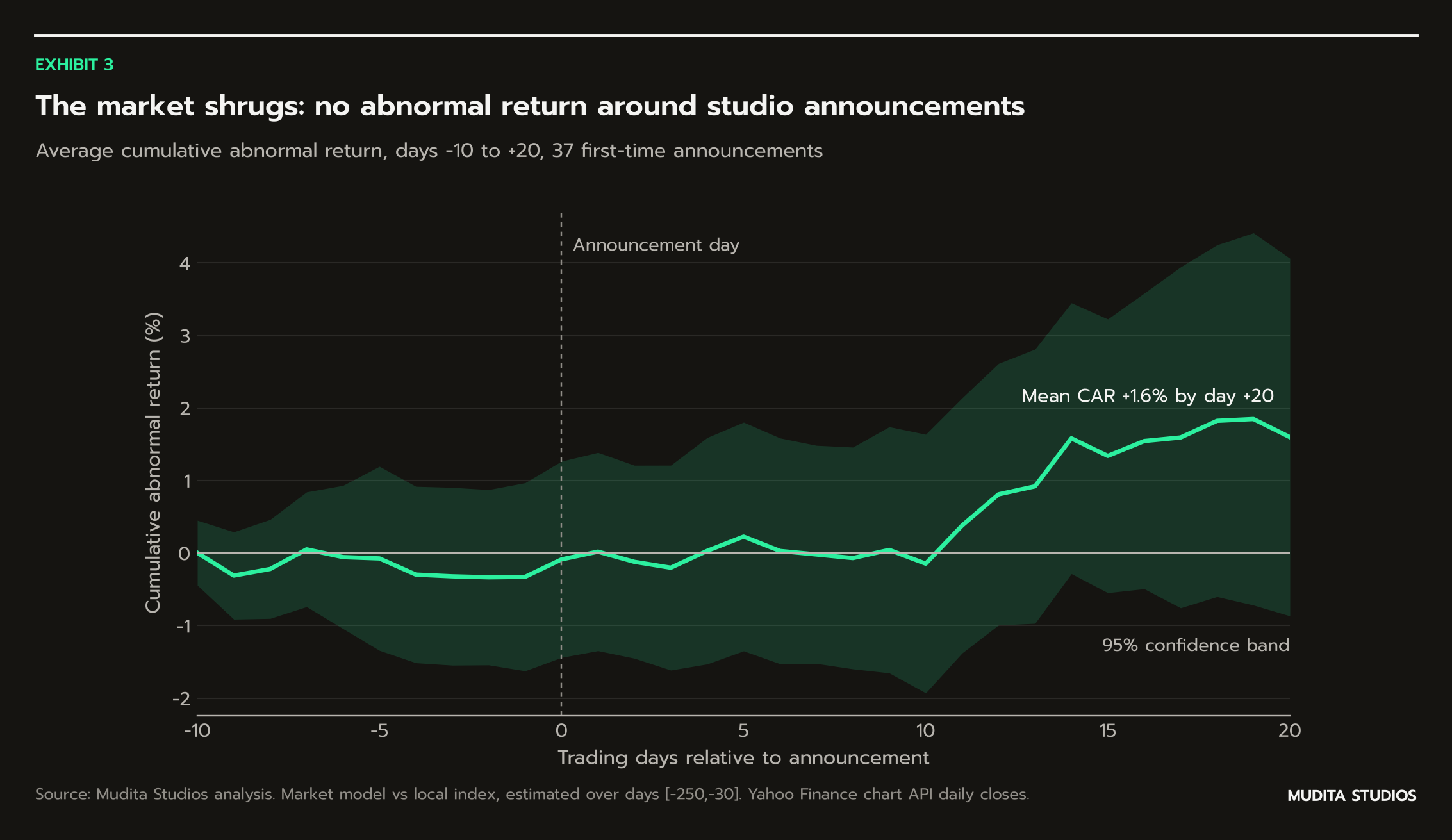
Exhibit 3. The market shrugs: no abnormal return around studio announcements.
Table 2: No announcement window shows a significant price reaction
| Window (trading days) | N | Mean CAR | Median CAR | 95% bootstrap CI | t (p) | BMP t (p) | % positive |
|---|---|---|---|---|---|---|---|
| [−1, +1] | 37 | +0.35% | +0.17% | −0.52% to +1.24% | 0.77 (0.45) | 0.70 (0.49) | 57% |
| [−3, +3] | 37 | +0.10% | +0.03% | −1.14% to +1.26% | 0.15 (0.88) | 0.17 (0.86) | 54% |
| [0, +10] | 37 | +0.18% | +0.53% | −1.61% to +1.90% | 0.20 (0.84) | 0.41 (0.68) | 54% |
Source: Mudita Studios analysis. Market model vs local index; BMP = Boehmer, Musumeci & Poulsen standardized test [S011].
None of the tests comes close to significance:
- the parametric t-test, the standardized BMP test, the sign test and the Wilcoxon test;
- a simpler market-adjusted model, which gives +0.55% for [−1, +1] (p = 0.22);
- eight subsamples: excluding Flagship, excluding Rocket Internet, Founders Factory only, co-creation JVs only, equity stakes only, high-confidence dates only, and US-listed versus non-US-listed.
The largest subsample effect is Founders Factory's +1.0% (t = 1.86, n = 15). With eight subsamples tested, that is what chance alone would produce. We don't treat it as a finding.
This null was the expected result, and it is a finding in itself. The cross-sectional standard deviation of 3-day CARs in our sample is 2.8%. With 37 events, the smallest average reaction we could reliably detect (80% power, 5% two-sided) is about 1.3% (Exhibit 4). The prior evidence points to effects well below that. A senior thesis at NYU Stern found mean CARs of −0.10% to +0.01% on 2,493 corporate venture investments [S005]. Studio commitments are typically tiny relative to a large-cap's market value. Detecting a +0.5% effect would take about 245 events, which is more announcements than we believe exist.
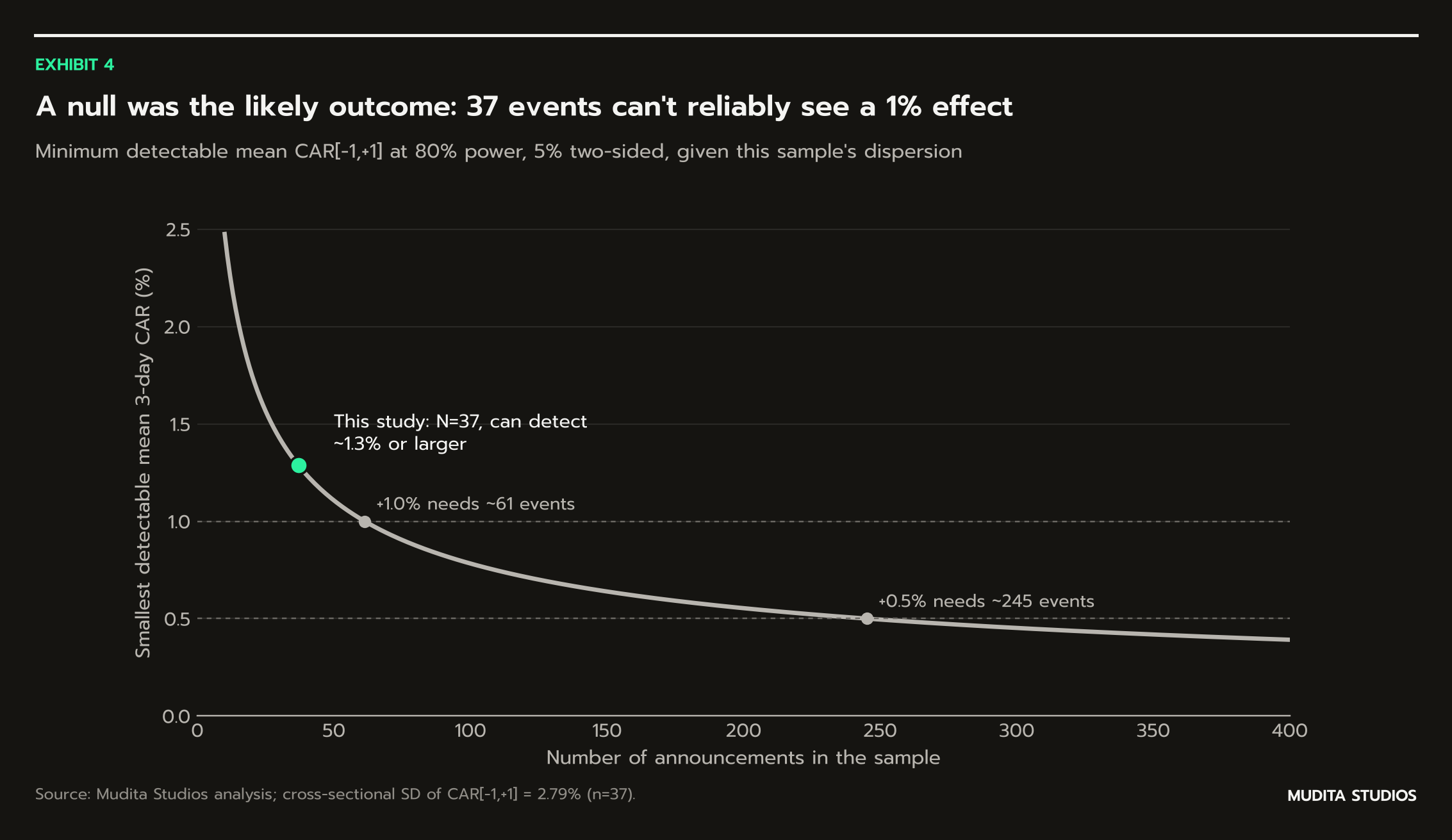
Exhibit 4. A null was the likely outcome: 37 events can't reliably see a 1% effect.
04
Analysis B2: did partners outperform over the following years?
Value from new ventures arrives slowly, if it arrives at all. So we measured buy-and-hold abnormal returns (BHARs) over 1, 2 and 3 years after each announcement. We used two benchmarks:
- the local listing index;
- a sector ETF, with the stock converted to US dollars and both measured on a total-return basis.
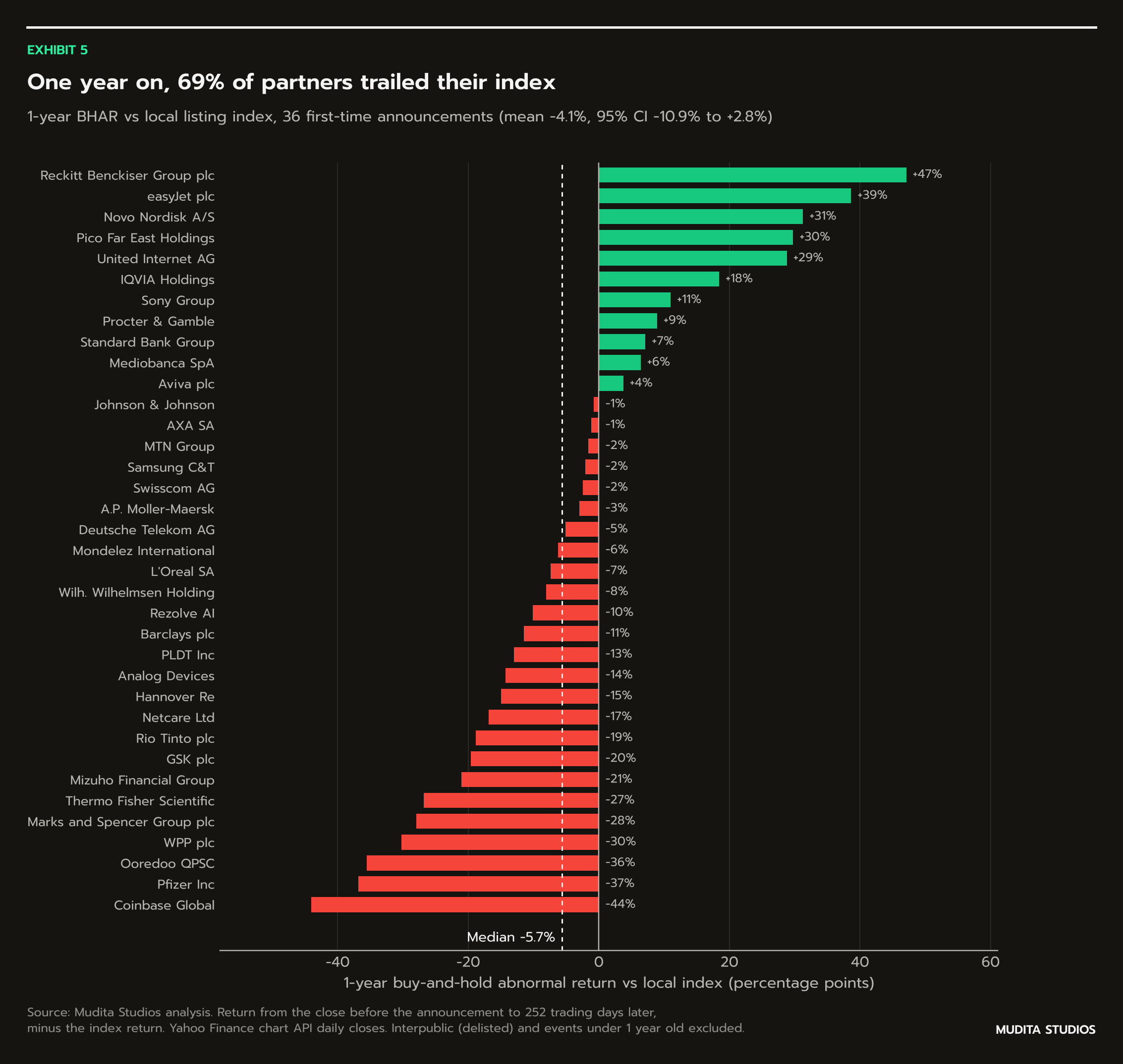
Exhibit 5. One year on, 69% of partners trailed their index.
Table 3: Long-horizon returns are indistinguishable from, or slightly below, the benchmarks
| Horizon | Benchmark | N | Mean BHAR | Median BHAR | 95% bootstrap CI | Skewness-adjusted t (p) | % positive |
|---|---|---|---|---|---|---|---|
| 1 year | Local index | 36 | −4.1% | −5.7% | −10.9% to +2.8% | −1.11 (0.27) | 31% |
| 1 year | Sector ETF (USD) | 36 | −7.9% | −10.8% | −15.6% to −0.1% | −1.89 (0.07) | 36% |
| 2 years | Local index | 34 | −8.2% | −5.3% | −20.4% to +4.7% | −1.25 (0.22) | 38% |
| 3 years | Local index | 28 | −1.5% | +1.7% | −17.9% to +15.3% | −0.16 (0.87) | 50% |
| 3 years | Sector ETF (USD) | 27 | −11.8% | −21.4% | −29.4% to +6.9% | −1.16 (0.26) | 33% |
Source: Mudita Studios analysis. Skewness-adjusted t from Lyon, Barber & Tsai [S012].
Partners don't outperform. If anything they lag slightly: against sector ETFs, the one-year bootstrap interval only just excludes zero. We wouldn't build a story on that number, for three reasons:
- it isn't significant against the local index;
- it fades at two and three years;
- overlapping event windows make the t-statistics look more precise than they are.
The underperformance is concentrated in the ten US-listed partners (mean one-year BHAR −12.5%), a group that includes Coinbase (−44%), Pfizer (−37%) and Thermo Fisher (−27%). With n = 10, that result rests on a few names. The fairest reading is that the partner's stock tracks its own business and its sector, and the studio deal is too small to change that.
05
The exception that proves the rule
Over the three days around 6 September 2024, Next 15 Group lost 45% of its value. A major client hadn't renewed its contract with Mach49, the venture builder Next 15 had bought in 2020, and that contract was expected to bring in just over £80m of revenue [S015]. When Next 15 announced in August 2025 that it would wind Mach49 down, the market-adjusted move was −0.5% [S016].
Table 4: Markets do react when the studio is material
| Event | Date | Stock return [−1, +1] | Market-adjusted [−1, +1] |
|---|---|---|---|
| Next 15 acquires Mach49 | 2020-09-01 | +2.5% | +3.5% |
| Next 15 profit warning: Mach49 client loss | 2024-09-06 | −44.9% | −44.9% |
| Next 15 to wind down Mach49 | 2025-08-28 | −1.3% | −0.5% |
| Aviva renews Founders Factory | 2021-10-08 | +1.7% | −0.5% |
| Aviva extends Founders Factory | 2026-09-29 | −1.8% | −1.0% |
Source: Mudita Studios analysis; Yahoo Finance [S004]; Sharecast [S015]; Global Venturing [S016].
The lesson is straightforward. Markets price what is material. A partnership announcement by a large-cap insurer is a rounding error. A venture builder that supplies a large share of a mid-cap's revenue is not.
06
What does matter
If the announcement doesn't move the stock, does anything?
- Strategic fit. The best peer-reviewed evidence shows that corporate venturing is associated with higher firm value (Tobin's q) when it is strategic and tied to the core business, not purely financial [S006]. The NYU Stern thesis found the only significant positive reactions among same-industry deals [S005].
- Value accrues over the life of a project, not on announcement day. Sood and Tellis find that the total market return to an innovation project is about 13 times the return to any single announcement about it [S014].
- Experience. McKinsey's 2024 survey of 1,176 executives found that companies putting about 20% of growth capital into new ventures report revenue growth 2 percentage points higher than non-builders. "Expert" serial builders report 2.8 points more organic growth and twice the success rate of novices [S002]. These figures are self-reported by a firm that sells venture-building services, so treat them as directional. The base rate is sobering: of the new businesses large companies launched in 2011–2014, more than half had been discontinued or had less than $1m in revenue four or more years later, and only about one in five scaled past $50m [S003].
- Persistence. Aviva's partnership with Founders Factory, now in its eleventh year, has supported more than 60 startups that have raised more than £500m, according to Aviva [S143]. Aviva hasn't disclosed its own financial return. Neither renewal announcement moved the stock (Table 4).
The honest pitch for a studio partnership is not "your share price will rise." It is that venture building is a capability, that capability compounds with repetition, and a studio lets a company borrow experience it would otherwise take a decade to build. That claim can be tested, but only with operating outcomes, not three-day returns. The evidence on studios themselves is also mixed. An independent PitchBook-based analysis found studio-backed companies exited 24% of the time, against 38% for VC-backed companies [S009]. The often-quoted "53% vs 21% IRR" is a self-reported 2020 trade-body figure [S010].
07
What a definitive study would need
This study is a first look, not the last word. A definitive version would need:
- A complete event census. Factiva or RavenPack to capture every announcement, including the many partnerships disclosed only by the studio, and to screen out confounding news (earnings, M&A, guidance) within ±2 days. We did not screen for confounds.
- Institutional price and factor data. CRSP and Compustat through WRDS, plus Datastream for non-US listings. With those, the study could use Fama-French/Carhart factor models with local factors instead of a single-index market model.
- A matched control group. Propensity-matched non-partner peers (industry, size, book-to-market, momentum, prior CVC activity), with calendar-time portfolio regressions to handle overlapping events. Selection is the core problem: firms often turn to outside venturing when internal innovation is weak [S007].
- Operating outcomes. Revenue growth, Tobin's q, R&D productivity and patents, plus the outcomes of the studio ventures themselves (PitchBook or Crunchbase).
- Scale and independence. Roughly 250 events to detect a +0.5% reaction, a pre-registered design, and an academic co-author. A study funded by a studio will rightly be read as marketing without these.
Implications
What this means for corporate innovation leaders
- Don't pitch a studio partnership to the board on share-price grounds. Announcements carry no measurable premium.
- Judge a partnership on operating outcomes such as venture revenue, survival and R&D productivity, measured over years.
- Tie ventures to the core business. The evidence of value creation sits with strategic, same-industry venturing.
- Plan for repetition. Venture-building capability compounds, and a studio lets a company borrow experience that takes a decade to build.
Appendix
Method, data and sources
Methodology and limitations
- Sample. We hand-collected 44 announcements from press releases, company announcements and trade press. Inclusion required a listed corporate partner, an external studio or venture builder, and a datable public announcement. Eight first-time dates rely on trade press or an inferred detail rather than a dated primary release, and are flagged as medium confidence. Dropping them doesn't change any conclusion. The sample is skewed toward Founders Factory, Europe, and studios that publicize their partners.
- Prices. Yahoo Finance chart API daily closes [S004]. Local benchmarks are the main national index. There are three proxies: MSCI EM for Ooredoo (Qatar), the iShares MSCI Philippines ETF for PLDT's NYSE ADR, and the OMX Copenhagen all-share for Danish stocks. Total-return series (SPY, DAX, OSEBX, ETFs) are paired with dividend-adjusted stock prices, and price indices with price-only stock series.
- Event study. Market model estimated over days −250 to −30 (221 observations per event). Day 0 is the first trading day on or after the announcement. Samsung C&T uses the next Korean session because the release came out overnight in Korea. Tests are cross-sectional t, BMP, sign, Wilcoxon, and a bootstrap of 10,000 resamples.
- Long horizon. BHARs run from the close before the announcement to 252, 504 and 756 trading days later. BHARs are skewed and events overlap in calendar time, so we report skewness-adjusted t-statistics and bootstrap intervals, and still read the p-values generously.
- Exclusions. Interpublic's missing price history is a survivorship gap that CRSP would close.
- Causality. Nothing here identifies a causal effect, in either direction.
The dataset, analysis code and full source list are available on request.
Sources
- [S001] Shackelford, M. (2024). The Stock Price Impact of Launching a Corporate Venture Capital Program. CP Ventures/Touchdown, Medium. (Practitioner analysis; self-interested publisher.)
- [S002] McKinsey & Company (2024). How CEOs are turning corporate venture building into outsize growth. (Industry survey, n = 1,176; self-reported.)
- [S003] McKinsey & Company (2021). 2021 global report: The state of new-business building. (Industry survey.)
- [S004] Yahoo Finance chart API, daily prices to 14 Oct 2026. (Independent data.)
- [S005] Sinha, P. (2018). Corporate Venture Capital: Stock Market Reactions and Impact on Investee Exit. NYU Stern honors thesis. (Not peer-reviewed.)
- [S006] Dushnitsky, G. & Lenox, M. (2006). When does corporate venture capital create firm value? Journal of Business Venturing. (Peer-reviewed.)
- [S007] Ma, S. (2020). The Life Cycle of Corporate Venture Capital. Review of Financial Studies. (Peer-reviewed.)
- [S009] Inniches (2024). PitchBook-based studio exit comparison. (Independent data.)
- [S010] Global Startup Studio Network (2020). Studio IRR figure. (Self-reported trade-body data.)
- [S011] Boehmer, E., Musumeci, J. & Poulsen, A. (1991). Journal of Financial Economics. (Method.)
- [S012] Lyon, J., Barber, B. & Tsai, C. (1999). Journal of Finance. (Method.)
- [S014] Sood, A. & Tellis, G. (2009). Marketing Science. (Peer-reviewed.)
- [S015] Sharecast (6 Sep 2024). Next 15 shares halve as major client walks.
- [S016] Global Venturing (29 Aug 2025). Next 15 shutting Mach49 after misconduct allegations.
- [S101–S144] Per-event press releases and reports; the full list is available on request.